


When to Start CRO: The 3 Stages of DTC Growth (and When It's Too Early)
A store doing about $130,000 a month. Around 60,000 sessions, a 2% conversion rate. Six weeks ago the team launched a product page test, a new headline and reviews pulled above the fold. This morning the variant is ahead by 6%, in green. Next to the green sits a small grey badge. Not significant.
Somebody says what the room is thinking. "So CRO doesn't work for us." The test gets switched off, and by Friday the budget for the next one has moved back to Meta.
If I'd been on that call, I'd have said one thing. The test didn't fail. It went blind.
Even if every session had entered the test, six weeks of that store's traffic is roughly 83,000 visitors split between two versions, enough to confirm a lift of about 14% or more. Confirming 6% needed around 430,000 sessions, more than seven months of traffic. The 6% may well have been real. The test was never going to be able to say.
So if you're sure you don't have enough traffic for CRO, you're probably right about the testing part. A store that can't A/B test yet still has plenty of CRO to do, though, and which kind depends on the stage it's in.
- When does CRO make sense? Why the published answers disagree
- How small a win can your traffic see?
- Revenue tells you the stage, traffic tells you what you can test
- Stage 1: product market fit, under $100K a month
- Stage 2: growth, $100K to $500K a month
- Stage 3: scale, $500K a month and up
- Signs you've misread your stage
When Does CRO Make Sense? Why the Published Answers Disagree
• CXL's rule of thumb, first published in 2015 and updated in 2022, puts the line at roughly 1,000 transactions a month and says that below it, your effort is better spent elsewhere.
• Blend Commerce recommends at least 50,000 monthly sessions, as its own guideline rather than a hard rule.
• Splitbase sets the bar at 3,000 orders a month, below which it says you probably won't reach significance.
At a 2% conversion rate, 50,000 sessions is 1,000 orders, so CXL and Blend are drawing the same line in different units. Splitbase draws it three times higher.
None of them says where the number comes from. Here's a reading that fits the arithmetic: at 1,000 orders a month, four weeks of traffic can confirm lifts of about 18% and up, and at 3,000 orders, about 10%. Both lines are defensible. They assume you're hunting for different sizes of win.
So how big is a typical win? The best public figure I know of comes from Analytics-Toolkit, which looked at 1,001 A/B tests run on its platform since late 2021. Among tests that produced a statistically significant win, the median lift was 7.5%, and about a third of all tests ended as significant wins. The analysis was run by Georgi Georgiev, the statistician who founded Analytics-Toolkit, wrote Statistical Methods in Online A/B Testing and teaches A/B testing statistics at CXL. He notes that the set leans toward experienced practitioners. It describes skilled testing programs. How well it maps onto the average store, the data doesn't say.
7.5% is small. Most early stage stores can't see it at all.
How Small a Win Can Your Traffic See?
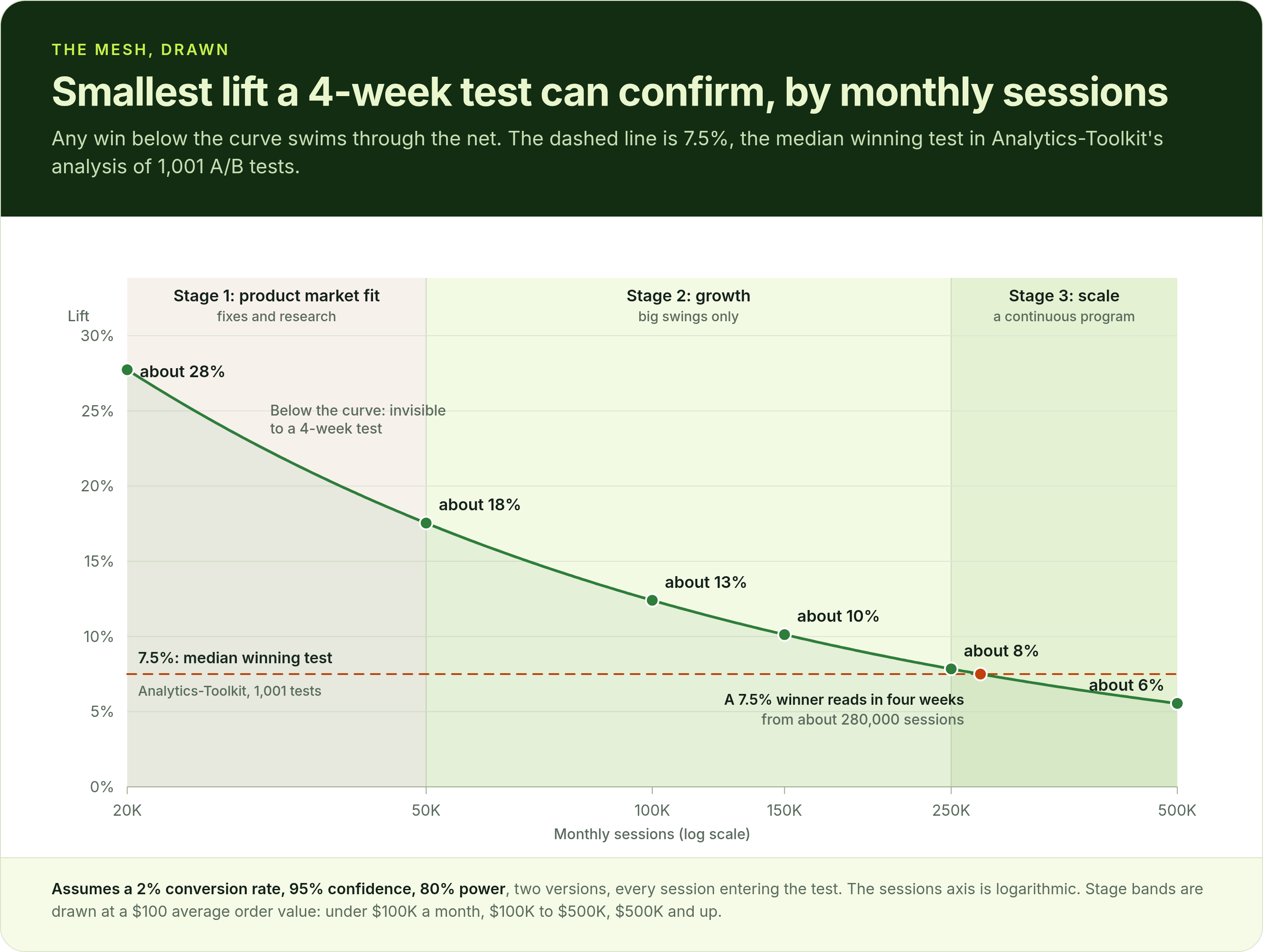
That 18% is the mesh of your net. Any win smaller than the holes swims straight through, and at 50,000 sessions a 7.5% win doesn't even touch the sides. The net comes up empty, and the crew decides the lake is dead.
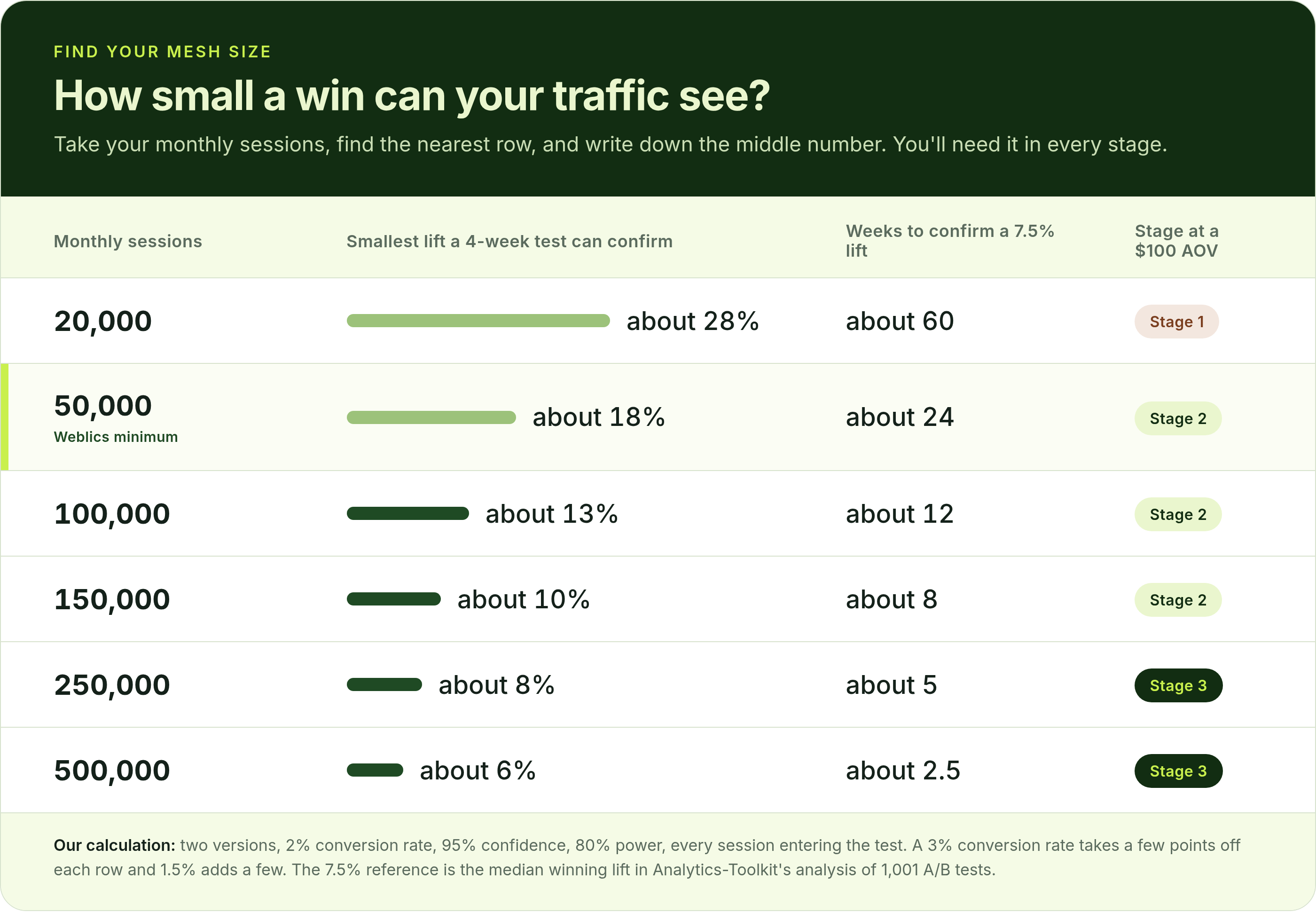
Where This Table Falls Short
The table also assumes every session enters the test. A test that runs on product pages sees just the traffic that reaches them, so look up that number instead of your total.
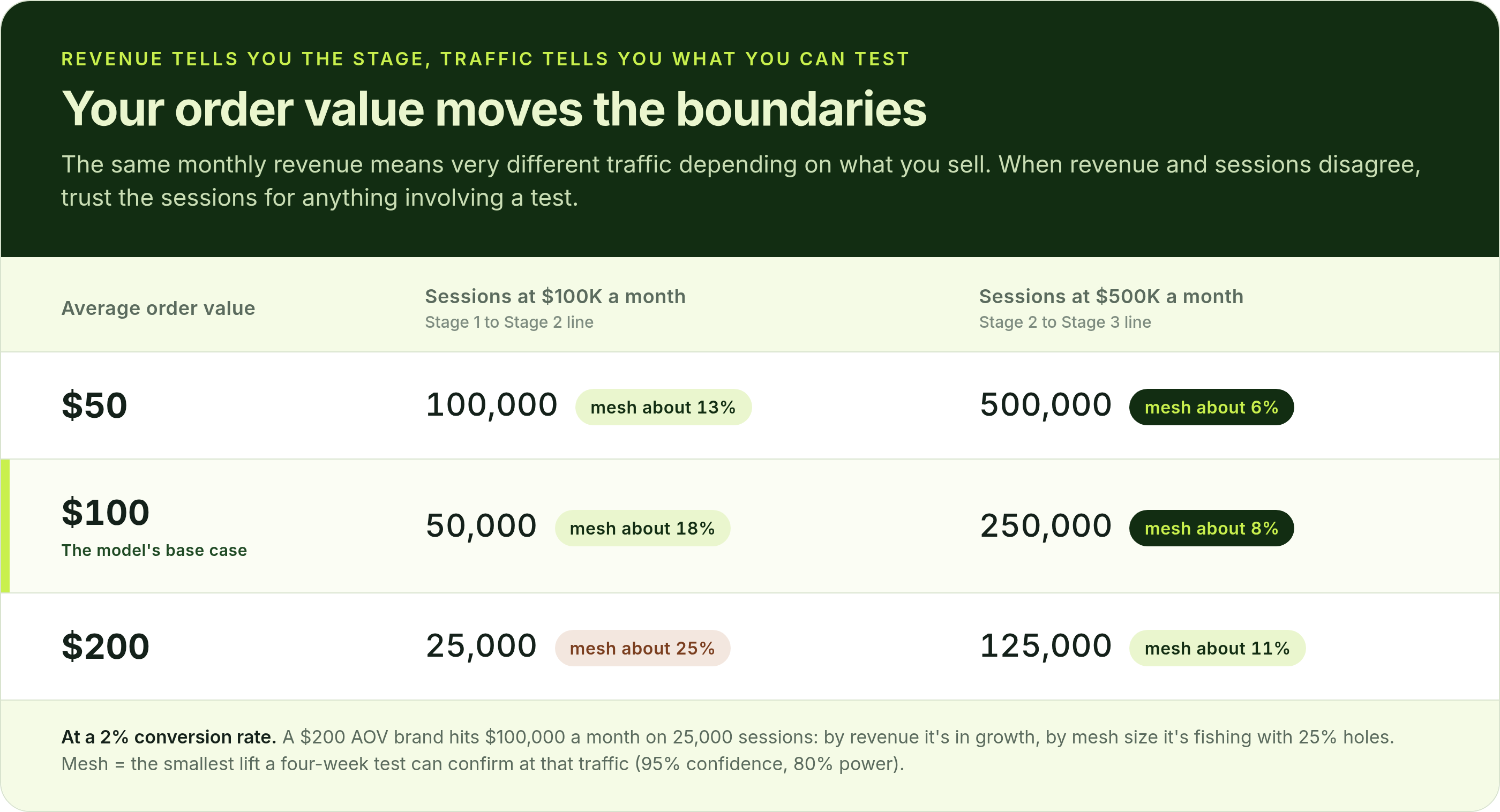
So what stage is a store with 60,000 sessions in? Depends what it sells.
Revenue Tells You the Stage. Traffic Tells You What You Can Test.
That's why the three stages sit where they do. It's our model, and we'd rather say so than dress it up as an industry standard. The boundaries are where published testing thresholds and the size of a typical win line up at a $100 order.
Your order value moves them:
Stage 1: Product Market Fit, Under $100K a Month
If the number you wrote down is above 20%, you're here, whatever your revenue says.
• Fix what's broken first. Checkout errors, slow mobile pages, variants that don't load, a discount field that eats orders.
• Watch real people use the site. An hour of session recordings usually shows more than a month of dashboards.
• Talk to buyers and to people who almost bought. Five calls is often enough to hear the same objection twice.
• Question the offer before the page. If people don't want the product at this price, no layout will fix it.
CXL's list for low traffic sites looks much the same.
What's a waste here is anything built around testing. At this stage you don't need a CRO agency, and anyone selling you a testing program is selling tests your traffic can't read. Do you need a CRO agency yet? covers what to do instead, and the seven questions to ask before hiring one apply whenever you do.
It's also the reason Weblics doesn't run testing programmes on stores below 50,000 monthly sessions. Below that line, a program can't see enough to earn its fee.
Stage 2: Growth, $100K to $500K a Month
The store from the Monday call sat here, at the bottom of the band, running a test its traffic couldn't hold.
What reads at this stage is big swings. A restructured product page or a new promise on the first screen can plausibly move conversion by 15% or more. A new button color can't. Template changes count double, because one change to a template serving 200 products gets the traffic of all 200.
Everything else, ship on judgment. Blend Commerce's shorthand is test risk, fix certainty: if you're confident a change is right and the downside is small, ship it, track before and after, and save your traffic for the calls you can't make yourself.
If you want a starting list, 9 PDP Patterns We Test Before Spending Another Dollar on a Redesign was built for this stage: changes big enough to read and cheap enough to ship without a redesign.
You're leaving growth when a 7.5% winner reads in about five weeks, around 250,000 monthly sessions at a 2% conversion rate. Past that line, the risk flips.
Stage 3: Scale, $500K a Month and Up
At 500,000 sessions, even a template that sees half the traffic can finish a readable test roughly every five weeks. If about a third end as clear wins, as in the Analytics-Toolkit set, that's three or four confirmed wins a year from that one template. They stack.
This is where a line I keep coming back to holds hardest: conversion rate is the only growth input whose cost doesn't scale with the growth it produces. Ad spend has to climb for revenue to climb. A conversion lift, once found, keeps paying on every extra visitor at no extra cost. At $500,000 a month, 5% is about $25,000 a month, around $300,000 a year. The full argument is in The DTC Scaling Trap.
CRO here looks like a roadmap ranked by expected impact and effort, with a guardrail metric on every test. We compared the main scoring frameworks in ICE, PIE and RICE. The cadence matters as much as the ranking, and it shouldn't stop when one test loses.
The risk runs the other way now. Being early costs you a few wasted tests. Being late costs you every month the mesh was fine and nobody was fishing.
Signs You've Misread Your Stage
• Your tests keep ending inconclusive. Check your mesh before you blame the idea.
• Someone reports significant wins on a store under 50,000 sessions a month. It can happen with a large effect. It happens far more often when a test is stopped the first day the number looks good.
• Your revenue says growth and your sessions say stage one. High AOV stores land here first, and the sessions decide what you can test.
• You're past $500,000 a month and still shipping on opinion. That's where a month without a program costs the most.
Back to the Monday call. The team had three ways forward that morning. Switch the test off and decide CRO doesn't work, which is what they did. Keep running small tests for another seven months and hope one reads. Or check their mesh and pick the work it can see: fixes and research above 20%, big swings between 8% and 20%, a real program below 8%. Only the third gets an answer in weeks.
Your number is already written down.
The question was never whether you're big enough for CRO. It's whether your test can see what you're looking for.
Sources
• Blend Commerce, when to A/B test vs implement, 50,000-session guideline
• Splitbase, PPC vs CRO, 3,000-order threshold
• Analytics-Toolkit (Georgi Georgiev), "What can be learned from 1,001 A/B tests", 2022
• Evan Miller, A/B test sample size calculator (our table recomputed with it: 2% baseline, 95% confidence, 80% power)

.webp)
.webp)
.webp)
.webp)
.webp)
.webp)


Do you have any questions left?
Here are the answers for you
You can start fixing and researching at any size. A/B testing makes sense once your traffic can confirm the size of lift you're testing for, which at a 2% conversion rate means roughly 50,000 monthly sessions, or about 1,000 orders a month. Below that, a four-week test can only confirm lifts of around 20% and up.
Published guidelines run from about 50,000 monthly sessions (Blend Commerce) to 3,000 orders a month (Splitbase). At a 2% conversion rate, 50,000 sessions lets a four-week test confirm lifts of about 18%. Confirming a 7.5% lift, the median significant win in Analytics-Toolkit's analysis of 1,001 tests by experienced practitioners, takes roughly 280,000 sessions per test.
Yes, as long as it isn't A/B testing. For small ecommerce stores, CRO means fixing broken checkout and mobile issues, watching session recordings, talking to customers and checking the offer. None of that depends on traffic volume.
Early stage brands under about $100,000 a month should put time into CRO research and fixes and hold off on a testing program or agency retainer. At that size a test usually can't confirm the size of lift most winning changes produce, so the money buys inconclusive results.
Until it reaches the sample size you calculated before launch, in whole weeks so weekday and weekend shoppers are both counted. The median test in Analytics-Toolkit's set of 1,001 ran 30 days. Stopping a test the first time it looks significant inflates false wins.
Not below roughly 50,000 monthly sessions. Weblics doesn't run testing programmes under that line, because a program can't see enough there to earn its fee. Above it, whether an agency makes sense depends on your team and your stage, which we cover in Do you need a CRO agency yet?.
Every plan includes complete care-driven CRO - what varies is testing capacity and analysis depth.
All Plans Include:
Onboarding (First 5 days):
- Founder interviews & business deep-dive
- Comprehensive technical website audit
- Customer psychology analysis (ICP, 5 WHYs, SWOT)
- AI-trained buyer personas creation
- Ad creatives audit
- Marketing ecosystem review
Ongoing (Continuous):
- Psychology-first hypothesis generation
- Conversion-focused UX/UI design
- Strategic copywriting
- Shopify development & implementation
- A/B testing & QA
- Transparent reporting & documentation
- Strategy meetings (weekly or bi-weekly)
What Changes by Tier:
- Tests per month: 2, 4, 6, or 8 A/B tests
- Meeting frequency: Bi-weekly (Starter) or Weekly (Growth+)
- Analysis depth: Post-purchase surveys, support analysis, inventory strategy, KPI planning, quarterly planning (varies by tier)
Bonus (Growth+): Comprehensive email marketing audit from specialist partners
Flexible plans give you complete control over costs. You pay for the essential CRO work - strategy, hypothesis generation, analysis, A/B test and project management - whilst design, development, and QA are billed separately at $70/hourly only when you need them.
This is perfect if you have an in-house design or development team, or if you want to manage exactly what gets built and when. You're not locked into paying for services you don't need.
Scale plans include everything - strategy, analysis, design, development, QA, and implementation - in one predictable monthly retainer. No surprises, no separate invoices, just complete care-driven CRO delivered autonomously.
Choose Flexible if: You have internal resources or want precise cost control
Choose Scale if: You want fully autonomous, hands-off CRO with everything included
Transparent pricing based on your monthly traffic.
We charge based on traffic volume because testing capacity and statistical significance directly correlate with session count. The more traffic you have, the faster we can run tests and deliver results.
Pricing:
- Starter (50K-75K sessions): $1,650/mo - 2 tests
- Growth (75K-150K sessions): $3,500/mo - 4 tests
- Scale (150K-350K sessions): $6,600/mo - 6 tests
- Enterprise (350K+ sessions): $10,700/mo - 8 tests
No long-term contracts. Cancel anytime.
Every plan includes our 30-day profitability guarantee.
Not sure which plan fits?
Book a discovery call - I'll help you find the perfect match for your business.
Our battle-tested frameworks and systems validate every hypothesis before we build.
Phase 1: Onboarding (First 5 days)
- Deep-dive into your business, customers, and psychology
- Comprehensive technical audit
- 25+ care-driven optimisation hypotheses
- Custom roadmap delivered
Phase 2: Operational (Continuous)
- Validate hypotheses through AI-trained buyer personas
- Ask: "Does this genuinely serve customer needs - not manipulate?"
- Design, develop, and implement winning tests
- Rigorous QA across all devices
- Launch and monitor
Phase 3: Ongoing Analysis (Monthly)
- Behavioural segmentation & data analysis
- Post-purchase survey analysis (Growth+ plans)
- Support ticket insights analysis (Growth+ plans)
- Inventory strategy (Growth+ plans)
- Monthly KPI planning (Growth+ plans)
- Quarterly strategic planning (Scale+ plans)
Yes - but as an addition to our battle-tested frameworks, not the foundation.
We've built a proprietary AI system that validates every hypothesis against your actual buyer personas before we build anything. This ensures we only create optimisations your customers will genuinely respond to.
How it works:
- Our frameworks identify conversion opportunities
- We generate psychology-first hypotheses
- AI-trained buyer personas validate each hypothesis
- We ask: "Does this genuinely serve customer needs—not manipulate?"
- Only validated hypotheses get built and tested
This approach achieves 84% test success rate vs 45% industry average - because we validate with your actual customers before building, not after.
AI enhances our care-driven methodology. It doesn't replace genuine customer understanding.
Simply upgrade to the next tier for more included tests and enhanced ongoing analysis.
We're completely flexible - scale up or down based on your business needs. No penalties, no long-term lock-ins.
Want to discuss expanding your plan? Your dedicated CRO manager can adjust your package anytime.
Yes. No long-term contracts. Cancel anytime.
We earn your business every single month through results - not by trapping you in contracts.
If we don't make you profitable within 30 days, you pay nothing more until we deliver. That's our guarantee.
Most clients stay because care-driven CRO compounds month after month - each winning test keeps generating revenue whilst new tests add even more. But you're never locked in.
We're confident our results will speak for themselves.
Zero micromanagement required. We operate completely autonomously.
We're an extension of your business - making decisions with your profit margins AND mission in mind, not billable hours.
Your involvement:
- Initial onboarding: 2-3 hours (interviews, strategy alignment)
- Weekly/bi-weekly meetings: 30-60 minutes (strategy updates, results review)
- Ad-hoc questions: Slack chat for quick questions
We handle everything else:
- Hypothesis generation
- Design and copywriting
- Development and implementation
- QA across all devices
- A/B test management
- Data analysis and reporting
You focus on running your business. We focus on adding $50K+ monthly to your revenue.
That's the partnership.
We integrate with your existing tools—no forced changes.
Analytics: Shopify Analytics, Microsoft Clarity, GA4
Testing: Intelligems
Management: ClickUp, Figma, Slack
Your data stays in your systems. We integrate seamlessly.
We sign NDAs before any work begins. Your data is protected - always.
Security measures:
- Non-Disclosure Agreement (NDA) signed upfront
- Limited access permissions (only what's necessary)
- Data stored in your systems (we don't migrate your data)
- Team access restricted to assigned personnel only
- Regular security audits
We treat your business like our own - that includes protecting your data like it's our own.
You maintain full control over all access permissions and can revoke them anytime.
Guaranteed profitability in 30 days. $50K+ monthly revenue boost within 60 days.
Tangible outcomes:
But more than numbers - you'll understand your customers deeply, remove friction authentically, and build genuine relationships that compound revenue month after month.
- Increased conversion rates (50-100%+ improvements common)
- Higher average order values
- Improved ROAS (return on ad spend)
- Enhanced customer lifetime value
- Sustainable, compounding revenue growth
Our 84% hypothesis success rate means tests consistently work.
Real client results:
- ForKeeps Merch: $2.3M added revenue (+70% conversion rate)
- Organic Muscle: 128% conversion rate increase
- CKitchen: $1.1M added revenue over 22 months
- Mayven Studios: 50% conversion increase in 2 months
For as long as care-driven CRO continues delivering massive ROI - which typically compounds over 6+ months.
Why long-term partnerships work:
- Each winning test keeps generating revenue permanently
- New tests stack on top of previous wins
- Deeper customer understanding leads to better hypotheses
- Compounding effects multiply over time
Typical timeline:
- Months 1-3: Foundation + initial wins ($50K+ monthly added)
- Months 4-6: Compounding effects visible (wins multiply)
- Months 7-12: Sustainable growth system established
- 12+ months: Category-leading conversion rates achieved
Most clients stay 12-24+ months because results compound. But there's no lock-in - cancel anytime.
We earn your business every month through genuine results, not contracts.
Three simple steps:
Step 1: Book a Discovery Call 30-minute conversation to discuss your traffic, goals, and biggest challenges. We'll explore if we're a good fit and map out your path to $50K+ monthly revenue growth.
Step 2: Get Your Free Audit We'll conduct a comprehensive CRO audit of your website, deliver 25+ psychology-first hypotheses, and show you exactly where your biggest revenue opportunities are.
Step 3: Choose Your Plan & Launch Select the plan that fits your traffic and business needs. We'll onboard you within 5 days and have your first A/B test live within 10 days.
Ready to grow with care-driven CRO?
Or have more questions? Email us: garyk@weblics.agency

Spending more on

Getting less back?
Your ads aren't broken. The store they land on is.
Send us your URL and we'll show you which leaks are eating your ad spend, and which one to fix first.

Just honest findings on your store, within 48h.