


Why Your Shopify Conversion Rate Is Stuck (And What Data Says You Should Fix First)
The problem isn't usually your product. It's the tiny friction points - the unclear CTA, the slow-loading page, the trust signal that's missing - that quietly kill conversions on every visit. We've run over 500 A/B tests for Shopify stores, and the pattern is always the same: small, data-backed changes compound into major revenue lifts.
This guide covers 15 Shopify conversion rate optimization strategies pulled from real test results, behavioral psychology research, and patterns we see across dozens of DTC brands every quarter. No theory. No fluff. Just what works.
- What Is a Good Shopify Conversion Rate in 2026?
- How to Speed Up Your Shopify Store for Higher Conversions
- Product Page CRO: The Changes That Drive the Biggest Revenue Lifts
- How to Build Trust That Converts First-Time Shopify Visitors
- Cart and Checkout Optimization Strategies That Reduce Drop-Off
- Using Psychology-Based Copywriting to Increase Add-to-Cart Rate
- How to Measure and Track Shopify Conversion Rate Improvements
What Is a Good Shopify Conversion Rate in 2026?
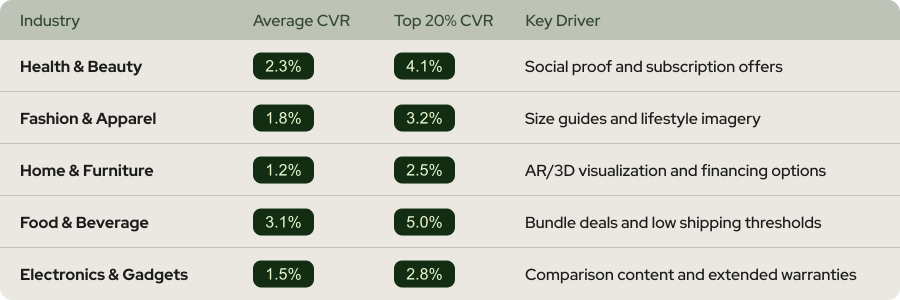
But here's where most benchmarking advice falls apart - averages don't tell the full story. Your conversion rate depends heavily on traffic source, product price point, and industry vertical. A $15 impulse-buy skincare brand converting at 4% isn't comparable to a $300 premium furniture store converting at 1.8%. Both could be performing well for their context.
Think of conversion rate like a batting average in baseball. A .300 average is elite, but it means you fail 70% of the time. The goal isn't perfection - it's consistent improvement, measured against your own baseline.
Shopify Conversion Rate Benchmarks by Industry
How to Speed Up Your Shopify Store for Higher Conversions
This isn't about chasing a perfect Lighthouse score - it's about reducing perceived wait time. Think of it like a restaurant: customers don't mind waiting 10 minutes for a great meal, but they'll walk out if they're standing at the door for 30 seconds without being acknowledged. Speed perception matters as much as actual milliseconds.
Here are the highest-impact speed fixes we consistently recommend for Shopify stores:
The 5 Speed Fixes That Actually Move Conversion Rate
Second, compress and lazy-load your images. Shopify's built-in CDN handles some of this, but large hero images and product gallery photos still need manual optimization. Aim for WebP format, and make sure images below the fold don't load until the visitor scrolls to them.
Third, minimize third-party scripts. Tracking pixels, chat widgets, pop-up tools - each one adds render-blocking JavaScript. Consolidate where you can, defer what you must keep, and remove anything that isn't directly tied to revenue.
Fourth, use Shopify's built-in features instead of app alternatives. Shopify's native product reviews, recently viewed products, and related products sections are lighter than most third-party apps that replicate the same functionality.
Fifth, consider your theme. Older or heavily customized themes carry technical debt. Sometimes the fastest speed improvement is migrating to a modern, performance-optimized theme like Dawn or Ride.
.svg)
Product Page CRO: The Changes That Drive the Biggest Revenue Lifts
The biggest mistake we see? Treating product pages like catalogs - a photo, a title, a price, and an "Add to Cart" button. That works for Amazon because they've already built decades of trust. Your Shopify store hasn't. Every element on the product page needs to do a job: answer an objection, build confidence, or push the visitor closer to clicking "Buy."
Here are the product page changes that consistently win A/B tests across DTC Shopify stores:
Above-the-Fold Elements That Increase Add-to-Cart Rate
One change that wins almost every time: adding a one-line value proposition directly under the product title. Something like "Clinically tested. 30-day supply. Free shipping over $50." This single line addresses three buying objections before the customer even thinks of them.
Below-the-Fold Content That Closes the Sale
Structure this content in expandable accordion sections. It keeps the page feeling clean while giving detail-hungry buyers everything they need. We've seen this layout increase time-on-page by 20-35% compared to long-scroll product descriptions.
How to Build Trust That Converts First-Time Shopify Visitors
Layer two: social proof. Customer reviews (ideally with photos), user-generated content, press logos, and influencer endorsements. The key is placing social proof close to the point of decision - next to the Add to Cart button, not buried on a separate reviews page.
Layer three: transactional trust. Payment badges (Visa, Mastercard, Apple Pay), SSL lock icon, clear return policy linked from the product page, and a visible customer service contact method. These answer the question "is it safe to buy here?"
Layer four: operational trust. Shipping timelines, order tracking, and clear delivery expectations. "Free shipping, arrives in 3-5 business days" converts better than "Free shipping" alone because it removes uncertainty.
Layer five: guarantee trust. Money-back guarantees, free returns, and satisfaction promises. The stronger your guarantee, the lower the perceived risk. Brands that offer a 60-day return window consistently outperform those offering 30 days - even though return rates barely change.
.svg)
Cart and Checkout Optimization Strategies That Reduce Drop-Off
Optimizing the cart and checkout flow is like fixing a leaky pipe. You don't need more water pressure (more traffic) - you need to plug the holes. And the holes are usually smaller than you'd expect: an unexpected shipping cost, a required account creation step, or a checkout that simply has too many fields.
Cart Page Quick Wins
Add a progress indicator. A simple "Cart → Shipping → Payment → Confirmation" bar at the top gives visitors a sense of control and expectation. It's the same reason elevators have floor indicators - people tolerate waiting better when they know how long it'll take.
Include a cart-level trust reassurance bar: "Free shipping over $75 | 30-day returns | Secure checkout." This single line, placed directly above the checkout button, addresses the three most common cart-stage anxieties in one shot.
Checkout Page Optimization for Shopify
Reduce form fields. Every additional field in your checkout increases the chance of abandonment. Shopify's newer checkout extensibility features let you customize the checkout without Liquid hacks. At minimum: combine first/last name into one field, auto-detect city from ZIP code, and remove the "Company" field unless you sell B2B.
Using Psychology-Based Copywriting to Increase Add-to-Cart Rate
Shopify ecommerce conversion strategies that rely on psychology outperform generic "best practices" because they tap into how the brain actually makes purchase decisions. And here's the thing most store owners miss - buying decisions are emotional first, rational second. People buy because something feels right, then look for logical reasons to justify the decision.
5 Psychological Triggers That Lift Conversions
Social proof at the decision point. Move your best review directly next to the Add to Cart button. Not in a carousel at the bottom of the page - right next to where the action happens. We've tested this across 20+ stores and it wins 80% of the time, with average lifts of 8-15% in add-to-cart rate.
Anchoring. Show the original price crossed out next to the discounted price. The brain uses the first number it sees as a reference point. "$89 ~~$129~~" feels like a deal. "$89" by itself is just a price. If you don't offer discounts, anchor against the cost of alternatives - "Less than $3/day" reframes a $89/month subscription as trivially cheap.
The power of "free." Free shipping, free samples, free returns - the word "free" activates the brain's reward center more powerfully than any discount. A product at $50 with free shipping converts better than the same product at $42 plus $8 shipping, even though the total cost is identical.
Commitment and consistency. Get a small "yes" before asking for the big one. This is why quizzes, product finders, and "build your bundle" tools work so well - each micro-interaction deepens the visitor's commitment to buying. By the time they see the Add to Cart button, they've already said "yes" three times in their head.
Writing Product Descriptions That Convert
Use the PAS framework: Problem, Agitate, Solve. Start with the pain your customer feels, make it vivid, then present your product as the relief. "Tired of moisturizers that leave your skin greasy by noon? (Problem) You end up blotting your face every two hours at work - not exactly the glow-up you were promised. (Agitate) Our oil-free formula absorbs in 30 seconds and keeps your skin matte until midnight. (Solve)"
Keep it scannable. Use short sentences. Break up paragraphs. Bold the key benefits. Your customer is on their phone, probably in line for coffee, giving you 8 seconds of attention. Don't waste it on a paragraph they won't read.
How to Measure and Track Shopify Conversion Rate Improvements
Think of it like a doctor reading bloodwork. Your overall conversion rate is like your temperature - it tells you something is happening, but it doesn't tell you why. You need to look at the individual metrics underneath to diagnose and treat the real issue.
The 5 Metrics That Matter Beyond Overall CVR
Add-to-cart rate tells you whether your product pages are doing their job. If traffic is strong but add-to-cart is below 5%, the problem is likely on the product page - imagery, copy, pricing, or trust signals.
Cart-to-checkout rate reveals friction in the cart experience. A healthy rate is 50-60%. Below 40% means something on the cart page is causing hesitation - usually an unexpected cost or missing trust element.
Checkout completion rate isolates the checkout flow. If people start checkout but don't finish, look at form complexity, payment options, and shipping cost reveals.
Revenue per visitor (RPV) is the metric that matters most. It combines conversion rate and average order value into a single number. A store that converts at 2% with a $100 AOV (RPV = $2.00) is outperforming a store that converts at 3% with a $50 AOV (RPV = $1.50).
Returning customer rate tells you about post-purchase experience and long-term brand strength. Returning visitors convert 2-3x higher than new visitors - so improving retention is often the fastest way to lift overall CVR.
How to Set Up Conversion Tracking in Shopify
For deeper insight, connect Google Analytics 4 (GA4) with enhanced ecommerce tracking. This lets you see conversion rates by traffic source, device type, landing page, and user segment. Shopify's native GA4 integration handles most of the event setup automatically - just make sure you've enabled "Enhanced Measurement" in your GA4 property settings.
For stores running active CRO programs, use a dedicated A/B testing platform. Tools like Convert, VWO, or AB Tasty let you run controlled experiments and measure statistical significance - so you know whether that 12% lift you saw last week was real or just normal fluctuation.


Do you have any questions left?
Here are the answers for you
A good Shopify conversion rate ranges from 2.5% to 3.5% for most DTC ecommerce stores. However, this varies significantly by product category, price point, and traffic source. A store selling $20 impulse-buy products from social media traffic will naturally convert higher than a $500 luxury goods store getting organic search traffic. Focus on improving your own baseline by 0.3-0.5% at a time rather than chasing an arbitrary benchmark.
Most Shopify stores see measurable improvements within 30-60 days of implementing data-backed changes. Quick wins - like fixing page speed, adding trust badges, or streamlining checkout - can show results in under two weeks. Deeper optimizations based on A/B testing typically need 2-4 weeks per test to reach statistical significance, with compounding gains over 3-6 months.
It can, but not always. A theme switch improves conversions when your current theme is slow, poorly structured for mobile, or lacks modern features like section-based product pages. Simply swapping to a "prettier" theme without addressing the underlying UX and copy issues won't move the needle. Theme migrations work best when paired with intentional CRO improvements to layout, content structure, and page speed.
You can absolutely start optimizing on your own - and should. The strategies in this guide are DIY-friendly. However, an experienced Shopify CRO agency adds value when you need rigorous A/B testing infrastructure, statistical analysis expertise, and a systematic testing roadmap. Agencies like Weblics run 10-20 concurrent experiments with proper controls, which is hard to replicate in-house without dedicated resources. The ROI question is simple: if the agency generates more incremental revenue than their fee, it pays for itself.
A sub-1% conversion rate usually signals one of three problems: your traffic quality is poor (visitors aren't your target audience), your product-market fit messaging is off (visitors don't immediately understand why they should buy), or there's a major technical friction point (slow speed, broken mobile experience, checkout errors). Start by checking your analytics for device-specific conversion rates. If mobile converts dramatically lower than desktop, you likely have a mobile UX issue. If both are low, revisit your traffic sources and product page messaging.
Almost always improve conversion rate first. Here's why: if your store converts at 1% and you double your traffic, you get 2x the sales. But if you improve your conversion rate to 2% at your current traffic level, you also get 2x the sales - without spending more on ads. The math is the same, but the CRO path is cheaper, faster, and makes every future dollar of ad spend more efficient. Fix the leaky bucket before you pour more water into it.
Every plan includes complete care-driven CRO - what varies is testing capacity and analysis depth.
All Plans Include:
Onboarding (First 5 days):
- Founder interviews & business deep-dive
- Comprehensive technical website audit
- Customer psychology analysis (ICP, 5 WHYs, SWOT)
- AI-trained buyer personas creation
- Ad creatives audit
- Marketing ecosystem review
Ongoing (Continuous):
- Psychology-first hypothesis generation
- Conversion-focused UX/UI design
- Strategic copywriting
- Shopify development & implementation
- A/B testing & QA
- Transparent reporting & documentation
- Strategy meetings (weekly or bi-weekly)
What Changes by Tier:
- Tests per month: 2, 4, 6, or 8 A/B tests
- Meeting frequency: Bi-weekly (Starter) or Weekly (Growth+)
- Analysis depth: Post-purchase surveys, support analysis, inventory strategy, KPI planning, quarterly planning (varies by tier)
Bonus (Growth+): Comprehensive email marketing audit from specialist partners
Flexible plans give you complete control over costs. You pay for the essential CRO work - strategy, hypothesis generation, analysis, A/B test and project management - whilst design, development, and QA are billed separately at $70/hourly only when you need them.
This is perfect if you have an in-house design or development team, or if you want to manage exactly what gets built and when. You're not locked into paying for services you don't need.
Scale plans include everything - strategy, analysis, design, development, QA, and implementation - in one predictable monthly retainer. No surprises, no separate invoices, just complete care-driven CRO delivered autonomously.
Choose Flexible if: You have internal resources or want precise cost control
Choose Scale if: You want fully autonomous, hands-off CRO with everything included
Transparent pricing based on your monthly traffic.
We charge based on traffic volume because testing capacity and statistical significance directly correlate with session count. The more traffic you have, the faster we can run tests and deliver results.
Pricing:
- Starter (50K-75K sessions): $1,650/mo - 2 tests
- Growth (75K-150K sessions): $3,500/mo - 4 tests
- Scale (150K-350K sessions): $6,600/mo - 6 tests
- Enterprise (350K+ sessions): $10,700/mo - 8 tests
No long-term contracts. Cancel anytime.
Every plan includes our 30-day profitability guarantee.
Not sure which plan fits?
Book a discovery call - I'll help you find the perfect match for your business.
Our battle-tested frameworks and systems validate every hypothesis before we build.
Phase 1: Onboarding (First 5 days)
- Deep-dive into your business, customers, and psychology
- Comprehensive technical audit
- 25+ care-driven optimisation hypotheses
- Custom roadmap delivered
Phase 2: Operational (Continuous)
- Validate hypotheses through AI-trained buyer personas
- Ask: "Does this genuinely serve customer needs - not manipulate?"
- Design, develop, and implement winning tests
- Rigorous QA across all devices
- Launch and monitor
Phase 3: Ongoing Analysis (Monthly)
- Behavioural segmentation & data analysis
- Post-purchase survey analysis (Growth+ plans)
- Support ticket insights analysis (Growth+ plans)
- Inventory strategy (Growth+ plans)
- Monthly KPI planning (Growth+ plans)
- Quarterly strategic planning (Scale+ plans)
Yes - but as an addition to our battle-tested frameworks, not the foundation.
We've built a proprietary AI system that validates every hypothesis against your actual buyer personas before we build anything. This ensures we only create optimisations your customers will genuinely respond to.
How it works:
- Our frameworks identify conversion opportunities
- We generate psychology-first hypotheses
- AI-trained buyer personas validate each hypothesis
- We ask: "Does this genuinely serve customer needs—not manipulate?"
- Only validated hypotheses get built and tested
This approach achieves 84% test success rate vs 45% industry average - because we validate with your actual customers before building, not after.
AI enhances our care-driven methodology. It doesn't replace genuine customer understanding.
Simply upgrade to the next tier for more included tests and enhanced ongoing analysis.
We're completely flexible - scale up or down based on your business needs. No penalties, no long-term lock-ins.
Want to discuss expanding your plan? Your dedicated CRO manager can adjust your package anytime.
Yes. No long-term contracts. Cancel anytime.
We earn your business every single month through results - not by trapping you in contracts.
If we don't make you profitable within 30 days, you pay nothing more until we deliver. That's our guarantee.
Most clients stay because care-driven CRO compounds month after month - each winning test keeps generating revenue whilst new tests add even more. But you're never locked in.
We're confident our results will speak for themselves.
Zero micromanagement required. We operate completely autonomously.
We're an extension of your business - making decisions with your profit margins AND mission in mind, not billable hours.
Your involvement:
- Initial onboarding: 2-3 hours (interviews, strategy alignment)
- Weekly/bi-weekly meetings: 30-60 minutes (strategy updates, results review)
- Ad-hoc questions: Slack chat for quick questions
We handle everything else:
- Hypothesis generation
- Design and copywriting
- Development and implementation
- QA across all devices
- A/B test management
- Data analysis and reporting
You focus on running your business. We focus on adding $50K+ monthly to your revenue.
That's the partnership.
We integrate with your existing tools—no forced changes.
Analytics: Shopify Analytics, Microsoft Clarity, GA4
Testing: Intelligems
Management: ClickUp, Figma, Slack
Your data stays in your systems. We integrate seamlessly.
We sign NDAs before any work begins. Your data is protected - always.
Security measures:
- Non-Disclosure Agreement (NDA) signed upfront
- Limited access permissions (only what's necessary)
- Data stored in your systems (we don't migrate your data)
- Team access restricted to assigned personnel only
- Regular security audits
We treat your business like our own - that includes protecting your data like it's our own.
You maintain full control over all access permissions and can revoke them anytime.
Guaranteed profitability in 30 days. $50K+ monthly revenue boost within 60 days.
Tangible outcomes:
But more than numbers - you'll understand your customers deeply, remove friction authentically, and build genuine relationships that compound revenue month after month.
- Increased conversion rates (50-100%+ improvements common)
- Higher average order values
- Improved ROAS (return on ad spend)
- Enhanced customer lifetime value
- Sustainable, compounding revenue growth
Our 84% hypothesis success rate means tests consistently work.
Real client results:
- ForKeeps Merch: $2.3M added revenue (+70% conversion rate)
- Organic Muscle: 128% conversion rate increase
- CKitchen: $1.1M added revenue over 22 months
- Mayven Studios: 50% conversion increase in 2 months
For as long as care-driven CRO continues delivering massive ROI - which typically compounds over 6+ months.
Why long-term partnerships work:
- Each winning test keeps generating revenue permanently
- New tests stack on top of previous wins
- Deeper customer understanding leads to better hypotheses
- Compounding effects multiply over time
Typical timeline:
- Months 1-3: Foundation + initial wins ($50K+ monthly added)
- Months 4-6: Compounding effects visible (wins multiply)
- Months 7-12: Sustainable growth system established
- 12+ months: Category-leading conversion rates achieved
Most clients stay 12-24+ months because results compound. But there's no lock-in - cancel anytime.
We earn your business every month through genuine results, not contracts.
Three simple steps:
Step 1: Book a Discovery Call 30-minute conversation to discuss your traffic, goals, and biggest challenges. We'll explore if we're a good fit and map out your path to $50K+ monthly revenue growth.
Step 2: Get Your Free Audit We'll conduct a comprehensive CRO audit of your website, deliver 25+ psychology-first hypotheses, and show you exactly where your biggest revenue opportunities are.
Step 3: Choose Your Plan & Launch Select the plan that fits your traffic and business needs. We'll onboard you within 5 days and have your first A/B test live within 10 days.
Ready to grow with care-driven CRO?
Or have more questions? Email us: garyk@weblics.agency

Wait… Claim your free bonuses
Find out exactly where your store is leaking revenue — and where your ad spend is going to waste. No pitch, just data.
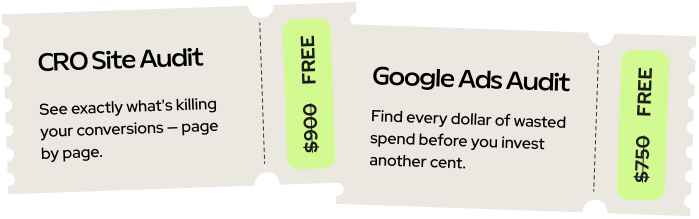
Just honest findings delivered within 2 business days.