


Why Every CRO Team Needs a Hypothesis Scoring Framework Before Running Tests
The cost of bad sequencing is real. Run a low-impact button color test while a checkout flow redesign sits in the queue, and you leave revenue on the table every single week. Think of a prioritization framework as a triage system for an emergency room. The most critical patients get treated first - not the ones who walked in first. A good framework does the same for your A/B tests: it scores every idea against consistent criteria so you always work on what matters most.
In this guide, we'll compare three proven hypothesis scoring frameworks - ICE, PIE, and RICE - with real examples, honest pros and cons, and a decision matrix to help you pick the right one for your team size and testing velocity.
- What Is a CRO Prioritization Framework and Why Does It Matter?
- ICE Scoring Model: The Fastest Way to Rank Test Ideas
- PIE Framework: Prioritization Built for CRO Teams
- RICE Prioritization Method: When Reach Changes Everything
- ICE vs PIE vs RICE: Side-by-Side Comparison
- How to Build a CRO Testing Roadmap With Your Chosen Framework
- Which Framework Should Your Team Use? A Decision Matrix
What Is a CRO Prioritization Framework and Why Does It Matter?
Here's why it matters more than most teams realize. If your store runs 2-3 A/B tests per month, that's roughly 30 experiments per year. Most CRO backlogs contain 50 or more ideas. Choosing the wrong order doesn't just waste a test - it delays the winning test that could have been generating revenue the entire time.
Think of it like packing a suitcase for a two-week trip. You can't take everything. A framework forces you to evaluate each item honestly: Will I actually wear this? How much space does it take? Is it versatile enough to justify its spot? Without that filter, you end up with four pairs of shoes and no socks.
The three most widely used frameworks in conversion rate optimization prioritization are ICE, PIE, and RICE. They all follow the same principle - score ideas against multiple factors to produce a ranking - but they differ in complexity, the factors they consider, and the team maturity they require. Let's break each one down.
ICE Scoring Model: The Fastest Way to Rank Your A/B Tests
Impact measures how much this experiment will move your target metric - conversion rate, average order value, revenue per visitor. A complete checkout redesign might score 9. Changing a button's border radius scores a 2.
Confidence captures how sure you are about your impact and ease estimates. A hypothesis backed by heatmap data, session recordings, and user surveys deserves an 8 or 9. A "gut feeling" idea? That's a 3. This factor is the honesty check that keeps optimism from hijacking your roadmap.
Ease is about implementation effort. How many hours of design and development does this need? A headline copy change is a 9. A dynamic pricing engine is a 2.
ICE Scoring Example for a Shopify Store
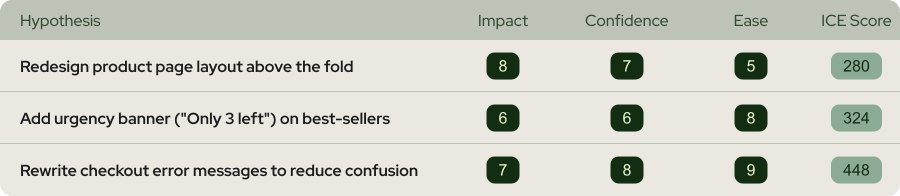
The checkout error message test wins - not because it's the flashiest, but because you have strong evidence (high confidence), the fix is simple (high ease), and the impact is solid. That's ICE doing exactly what it's supposed to do.
Where ICE falls short: With only three broad factors, two people can score the same idea very differently. There's no built-in mechanism to account for how many visitors a test will actually reach, which means a niche landing page test and a homepage test can look equally attractive on paper.
PIE Framework: Conversion Rate Optimization Prioritization for CRO Teams
Potential asks: How much room for improvement does this page have? This is where PIE gets smarter than ICE. Instead of guessing at abstract "impact," you look at real performance data. A page with a 1.2% conversion rate and industry benchmarks at 3.5% has high potential. A page already converting at 4.8%? Less potential - you're squeezing water from a stone.
Importance measures how much traffic and revenue flow through the page. Your homepage and product pages carry more weight than your shipping policy page. This factor naturally pushes your highest-traffic, highest-revenue pages to the top of the queue.
Ease works the same as in ICE - how simple is the test to implement?
Why PIE Uses Averages Instead of Multiplication
Think of it like grading a student. Multiplication is like saying "if you fail one subject, you fail everything." Averaging is like a GPA - one tough class doesn't ruin your transcript.
Where PIE falls short: PIE still relies on subjective scoring for the "Potential" dimension. A test inspired by deep user research and a test inspired by copying a competitor both get scored the same way. PIE doesn't differentiate based on evidence quality - it trusts your judgment equally regardless of how well-informed that judgment actually is.
RICE Prioritization Method: When Audience Reach Changes Everything
Reach quantifies how many users or sessions will encounter your experiment within a defined time period. A homepage banner test might reach 50,000 visitors per month. A test on a niche product category page might reach 800. That difference matters enormously - and neither ICE nor PIE captures it.
Impact is scored on a scale (commonly 0.25 for minimal, 0.5 for low, 1 for medium, 2 for high, 3 for massive) rather than 1-10. This keeps the scale manageable and forces teams to make deliberate choices.
Confidence is expressed as a percentage. 100% means you have strong data backing your hypothesis. 80% means reasonable evidence. Below 50%, the RICE framework essentially labels your idea a "moonshot" - probably not worth prioritizing over better-validated tests.
Effort is estimated in person-weeks or person-months. A one-week copy change and a three-month checkout rebuild are treated very differently. Because Effort sits in the denominator, higher effort scores pull the total RICE score down - naturally penalizing complex, resource-heavy tests.
RICE Scoring Example for Experiment Prioritization
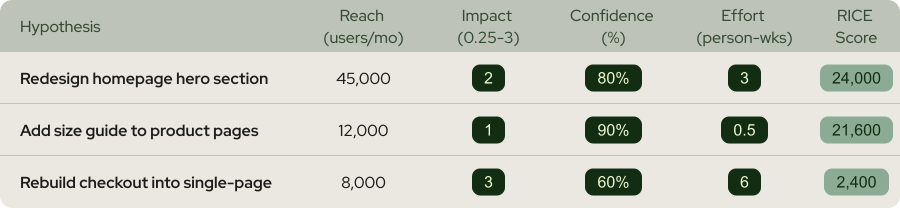
When RICE works best: Your team has access to solid traffic data per page, you're comparing experiments across very different parts of the funnel, and you need a framework that accounts for audience size. RICE shines when a homepage test and a thank-you page test are competing for the same slot.
Where RICE falls short: RICE requires more data upfront. You need page-level traffic numbers, realistic effort estimates, and honest confidence assessments. For smaller teams or newer CRO programs, gathering that data can slow down the prioritization process itself - which defeats the purpose.
ICE vs PIE vs RICE: Which Hypothesis Scoring Framework Wins?
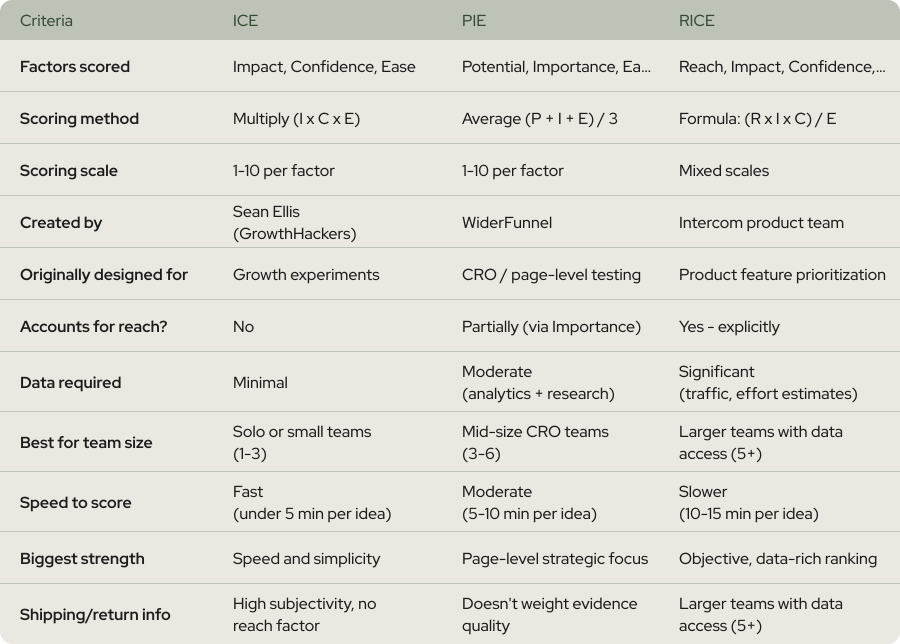
How to Build a CRO Testing Roadmap Using Prioritization Scores
Step 1: Score everything in your backlog. Pull every test idea into a spreadsheet. Apply your chosen framework. Don't cherry-pick - score all of them, even the ones you think are "obvious" winners. Gut feelings are often wrong, and that's exactly why you need a framework.
Step 2: Sort by score and group into tiers. Your top 10 ideas become Tier 1 (run these first). The next 10-15 are Tier 2 (run after Tier 1 tests conclude). Everything else goes into Tier 3 (revisit quarterly). This prevents the common mistake of re-debating your entire backlog every sprint.
Step 3: Map tests to your testing velocity. If you run 2-3 tests per month, your Tier 1 list covers roughly 3-5 months of work. Plot them on a calendar. Assign owners. Set expected launch dates. A testing roadmap without dates is just a wish list.
Step 4: Build in learning loops. After every test, update your backlog. A winning test might spawn three follow-up hypotheses. A losing test gives you data that changes confidence scores on related ideas. Your roadmap is a living document - treat it like one.
Think of your roadmap like a GPS route. The framework sets the destination (highest-impact tests first), but traffic conditions change. New data, seasonal shifts, or a product launch might reroute you. The roadmap gives you structure without making you rigid.
Which A/B Test Prioritization Framework Should Your Team Use?
Choose ICE if: You're running fewer than 3 tests per month. Your team is new to structured A/B test prioritization. You need to build the scoring habit before adding complexity. You don't have dedicated analytics support. You want to quickly sort a large backlog into rough priority tiers.
Choose PIE if: You have Google Analytics or Shopify Analytics data you trust. You've started collecting qualitative data like heatmaps, session recordings, and surveys. You want prioritization grounded in observable page performance. Your team includes 3-6 people who contribute test ideas. You need a framework that naturally maps to pages in your funnel.
Choose RICE if: You have page-level traffic data and can estimate reach with reasonable accuracy. Your test ideas span very different parts of the funnel (homepage vs. thank-you page). You need a framework that accounts for audience size differences. Your team has 5 or more people and needs defensible, data-rich prioritization. You're comparing experiments that vary wildly in implementation effort.
Choose a hybrid approach if: Your program is mature enough to handle two frameworks without slowing down. You want ICE for fast triage and RICE for deep-dive ranking. You use PIE quarterly to decide which pages to focus on, then ICE or RICE for individual experiments on those pages.
The real value of any framework isn't the specific score. It's the structured conversation about why certain tests should run before others. That conversation, repeated consistently, is what separates a random collection of test ideas from a strategic CRO program.
If you're not sure where to start, go with ICE. It takes five minutes to learn, one meeting to implement, and you can always graduate to PIE or RICE as your team's data maturity grows. The best framework is the one your team will actually use every single sprint.


Do you have any questions left?
Here are the answers for you
They're not the same - each framework optimizes for different strengths. ICE is best for speed and simplicity, PIE excels at page-level strategic focus, and RICE provides the most data-driven objectivity. The best choice depends on your team size, data maturity, and testing velocity. Most mature CRO programs eventually use a hybrid of two or more.
Absolutely. While these frameworks were built for CRO and product experiments, the logic applies to any situation where you need to rank competing ideas - including ad creative tests, landing page variants, and even email subject line experiments. Just adjust the scoring criteria to fit the context.
At minimum, every quarter. Traffic patterns shift, new qualitative data emerges, and completed tests change your assumptions about related hypotheses. A score that was accurate three months ago may be completely off today. Set a recurring calendar event so it doesn't slip.
That's actually a feature, not a bug. Divergent scores mean your team has different assumptions about impact, effort, or confidence. Use it as a conversation starter - discuss why scores differ, align on definitions, and converge on a shared score. Calibration sessions (agreeing on what a "7 Impact" means) solve most inconsistency.
PIE works great for Shopify stores. The "Importance" dimension maps naturally to Shopify's traffic reports - you can see exactly which pages get the most sessions and revenue. If you're running Shopify Analytics or GA4, you have everything you need to score PIE accurately, regardless of store size.
Yes - arguably even more so. When your testing slots are limited, every experiment counts more. A framework ensures you don't waste a precious test on a low-impact idea. At Weblics, we use prioritization scoring as part of every CRO audit to identify the highest-impact opportunities first, so even brands with moderate traffic get maximum value from each test.
Every plan includes complete care-driven CRO - what varies is testing capacity and analysis depth.
All Plans Include:
Onboarding (First 5 days):
- Founder interviews & business deep-dive
- Comprehensive technical website audit
- Customer psychology analysis (ICP, 5 WHYs, SWOT)
- AI-trained buyer personas creation
- Ad creatives audit
- Marketing ecosystem review
Ongoing (Continuous):
- Psychology-first hypothesis generation
- Conversion-focused UX/UI design
- Strategic copywriting
- Shopify development & implementation
- A/B testing & QA
- Transparent reporting & documentation
- Strategy meetings (weekly or bi-weekly)
What Changes by Tier:
- Tests per month: 2, 4, 6, or 8 A/B tests
- Meeting frequency: Bi-weekly (Starter) or Weekly (Growth+)
- Analysis depth: Post-purchase surveys, support analysis, inventory strategy, KPI planning, quarterly planning (varies by tier)
Bonus (Growth+): Comprehensive email marketing audit from specialist partners
Flexible plans give you complete control over costs. You pay for the essential CRO work - strategy, hypothesis generation, analysis, A/B test and project management - whilst design, development, and QA are billed separately at $70/hourly only when you need them.
This is perfect if you have an in-house design or development team, or if you want to manage exactly what gets built and when. You're not locked into paying for services you don't need.
Scale plans include everything - strategy, analysis, design, development, QA, and implementation - in one predictable monthly retainer. No surprises, no separate invoices, just complete care-driven CRO delivered autonomously.
Choose Flexible if: You have internal resources or want precise cost control
Choose Scale if: You want fully autonomous, hands-off CRO with everything included
Transparent pricing based on your monthly traffic.
We charge based on traffic volume because testing capacity and statistical significance directly correlate with session count. The more traffic you have, the faster we can run tests and deliver results.
Pricing:
- Starter (50K-75K sessions): $1,650/mo - 2 tests
- Growth (75K-150K sessions): $3,500/mo - 4 tests
- Scale (150K-350K sessions): $6,600/mo - 6 tests
- Enterprise (350K+ sessions): $10,700/mo - 8 tests
No long-term contracts. Cancel anytime.
Every plan includes our 30-day profitability guarantee.
Not sure which plan fits?
Book a discovery call - I'll help you find the perfect match for your business.
Our battle-tested frameworks and systems validate every hypothesis before we build.
Phase 1: Onboarding (First 5 days)
- Deep-dive into your business, customers, and psychology
- Comprehensive technical audit
- 25+ care-driven optimisation hypotheses
- Custom roadmap delivered
Phase 2: Operational (Continuous)
- Validate hypotheses through AI-trained buyer personas
- Ask: "Does this genuinely serve customer needs - not manipulate?"
- Design, develop, and implement winning tests
- Rigorous QA across all devices
- Launch and monitor
Phase 3: Ongoing Analysis (Monthly)
- Behavioural segmentation & data analysis
- Post-purchase survey analysis (Growth+ plans)
- Support ticket insights analysis (Growth+ plans)
- Inventory strategy (Growth+ plans)
- Monthly KPI planning (Growth+ plans)
- Quarterly strategic planning (Scale+ plans)
Yes - but as an addition to our battle-tested frameworks, not the foundation.
We've built a proprietary AI system that validates every hypothesis against your actual buyer personas before we build anything. This ensures we only create optimisations your customers will genuinely respond to.
How it works:
- Our frameworks identify conversion opportunities
- We generate psychology-first hypotheses
- AI-trained buyer personas validate each hypothesis
- We ask: "Does this genuinely serve customer needs—not manipulate?"
- Only validated hypotheses get built and tested
This approach achieves 84% test success rate vs 45% industry average - because we validate with your actual customers before building, not after.
AI enhances our care-driven methodology. It doesn't replace genuine customer understanding.
Simply upgrade to the next tier for more included tests and enhanced ongoing analysis.
We're completely flexible - scale up or down based on your business needs. No penalties, no long-term lock-ins.
Want to discuss expanding your plan? Your dedicated CRO manager can adjust your package anytime.
Yes. No long-term contracts. Cancel anytime.
We earn your business every single month through results - not by trapping you in contracts.
If we don't make you profitable within 30 days, you pay nothing more until we deliver. That's our guarantee.
Most clients stay because care-driven CRO compounds month after month - each winning test keeps generating revenue whilst new tests add even more. But you're never locked in.
We're confident our results will speak for themselves.
Zero micromanagement required. We operate completely autonomously.
We're an extension of your business - making decisions with your profit margins AND mission in mind, not billable hours.
Your involvement:
- Initial onboarding: 2-3 hours (interviews, strategy alignment)
- Weekly/bi-weekly meetings: 30-60 minutes (strategy updates, results review)
- Ad-hoc questions: Slack chat for quick questions
We handle everything else:
- Hypothesis generation
- Design and copywriting
- Development and implementation
- QA across all devices
- A/B test management
- Data analysis and reporting
You focus on running your business. We focus on adding $50K+ monthly to your revenue.
That's the partnership.
We integrate with your existing tools—no forced changes.
Analytics: Shopify Analytics, Microsoft Clarity, GA4
Testing: Intelligems
Management: ClickUp, Figma, Slack
Your data stays in your systems. We integrate seamlessly.
We sign NDAs before any work begins. Your data is protected - always.
Security measures:
- Non-Disclosure Agreement (NDA) signed upfront
- Limited access permissions (only what's necessary)
- Data stored in your systems (we don't migrate your data)
- Team access restricted to assigned personnel only
- Regular security audits
We treat your business like our own - that includes protecting your data like it's our own.
You maintain full control over all access permissions and can revoke them anytime.
Guaranteed profitability in 30 days. $50K+ monthly revenue boost within 60 days.
Tangible outcomes:
But more than numbers - you'll understand your customers deeply, remove friction authentically, and build genuine relationships that compound revenue month after month.
- Increased conversion rates (50-100%+ improvements common)
- Higher average order values
- Improved ROAS (return on ad spend)
- Enhanced customer lifetime value
- Sustainable, compounding revenue growth
Our 84% hypothesis success rate means tests consistently work.
Real client results:
- ForKeeps Merch: $2.3M added revenue (+70% conversion rate)
- Organic Muscle: 128% conversion rate increase
- CKitchen: $1.1M added revenue over 22 months
- Mayven Studios: 50% conversion increase in 2 months
For as long as care-driven CRO continues delivering massive ROI - which typically compounds over 6+ months.
Why long-term partnerships work:
- Each winning test keeps generating revenue permanently
- New tests stack on top of previous wins
- Deeper customer understanding leads to better hypotheses
- Compounding effects multiply over time
Typical timeline:
- Months 1-3: Foundation + initial wins ($50K+ monthly added)
- Months 4-6: Compounding effects visible (wins multiply)
- Months 7-12: Sustainable growth system established
- 12+ months: Category-leading conversion rates achieved
Most clients stay 12-24+ months because results compound. But there's no lock-in - cancel anytime.
We earn your business every month through genuine results, not contracts.
Three simple steps:
Step 1: Book a Discovery Call 30-minute conversation to discuss your traffic, goals, and biggest challenges. We'll explore if we're a good fit and map out your path to $50K+ monthly revenue growth.
Step 2: Get Your Free Audit We'll conduct a comprehensive CRO audit of your website, deliver 25+ psychology-first hypotheses, and show you exactly where your biggest revenue opportunities are.
Step 3: Choose Your Plan & Launch Select the plan that fits your traffic and business needs. We'll onboard you within 5 days and have your first A/B test live within 10 days.
Ready to grow with care-driven CRO?
Or have more questions? Email us: garyk@weblics.agency

Wait… Claim your free bonuses
Find out exactly where your store is leaking revenue — and where your ad spend is going to waste. No pitch, just data.
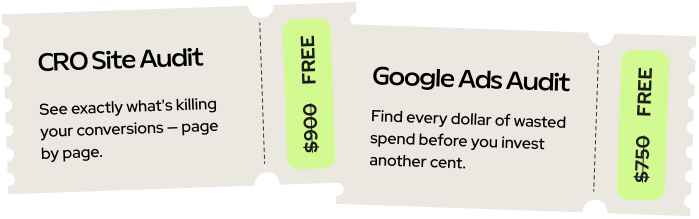
Just honest findings delivered within 2 business days.