


Why Ecommerce Buyer Psychology Determines the Sale Before You Scroll
- The 3-Second Threat Scan: What Your Visitor's Brain Does First
- Relevance Calibration: How Customers Decide the Page is "For Them"
- Trust Signals and the Trust Audit Every Visitor Runs
- Social Proof Psychology: Why Reviews Do More Than Build Confidence
- Loss Aversion and Urgency: The Loss Calculation That Drives Purchase
- Product Page Copywriting Psychology: How Words Trigger Decisions
- The Commitment Sequence: Designing for the Final Click
The 3-Second Threat Scan: What Your Visitor's Brain Does First
Think of it like walking into a physical shop. You don't read the signage first - you feel the place. Lighting, layout, cleanliness, how busy it is. Your brain decides whether to relax or stay alert before your rational mind gets involved. Your product page works the same way.
The threat scan evaluates a handful of signals almost simultaneously. Page load speed is the first filter - a slow page registers as a signal of an unreliable store before anyone sees your product. Visual hierarchy matters next: does the page look like a legitimate business, or does it look like something was thrown together? SSL indicators, familiar payment logos, and a clean layout all help the brain shift from "alert" to "relaxed." A relaxed visitor is a visitor who can be persuaded. An alert one is already halfway out the door.
What Triggers a Failed Threat Scan
Relevance Calibration: How Customers Decide the Page is "For Them"
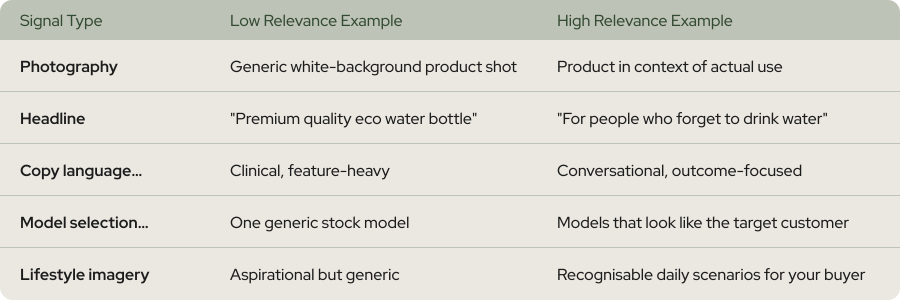
Here is a useful analogy. When someone walks into a shoe shop, they do not examine every shoe before deciding whether to stay. They look at the styles on display and immediately assess whether the shop matches their style identity. If it does, they stay and browse. If it doesn't, they leave in thirty seconds regardless of the quality.
Your product page makes the same identity pitch. The photography style, the model choices, the language register of the copy, the lifestyle imagery - all of it signals "this is for people like you" or "this is not your tribe." High-converting product pages make this identity match fast and obvious. They use photography that looks like the customer's life, copy that uses the language their customer uses, and benefit framing that speaks to values the customer already holds.
The relevance calibration phase is also where product page persuasion techniques at the copy level start to matter. A headline that names a specific pain, a specific person, or a specific context dramatically speeds up the "this is for me" decision. "The running shoe for people who run in the rain" converts faster than "premium all-weather running shoe" - not because it is more descriptive, but because it triggers identity recognition in the target customer while deliberately excluding everyone else.
Trust Signals and the Trust Audit Every Visitor Runs
Think of the trust audit like a loan application, but reversed. The visitor is the bank, and your product page is the applicant. They are scanning for credibility signals: social proof, authority markers, verified claims, transparency about shipping and returns. Every signal they find makes the "loan" - the purchase - more likely.
The trust audit is not a single moment. It plays out as the visitor scrolls. But the signals they find (or fail to find) in the first screenful of content carry the most weight. This is why trust elements belong above the fold or within the first scroll depth - not buried at the bottom of the page after the long-form description.
Social Proof Psychology: Why Reviews Do More Than Build Confidence
The numbers are stark. Displaying reviews can increase conversions by up to 270% when five or more reviews are present. 75% of consumers actively look for reviews and testimonials before purchasing from an online store, and 72% trust customer-submitted photos more than stock images. Social proof psychology in ecommerce is not just about having reviews - it is about how you frame and display them.
The bandwagon effect and social proof operate on a simple principle: popularity implies correctness. A product with 847 reviews is not just more trusted than one with 12 reviews - it is perceived as a fundamentally different category of product. The review count signals demand, and demand signals value. This is why growing your review count to a visible tipping point (typically above 50 reviews) is a higher-leverage CRO investment than almost any copy change.
But social proof psychology goes deeper than star ratings. 65% of consumers say seeing user-generated content - customer photos and videos - helps build trust during the buying process. The reason is that UGC answers the question the formal product description cannot: "What is this actually like in real life?" Customer photos showing the product in use, in their home, on their body - these perform a trust function that no amount of professional photography can replicate. They short-circuit scepticism at the source.
How to Make Your Social Proof Work Harder
Loss Aversion and Urgency: The Loss Calculation That Drives Purchase
The analogy that makes this concrete: imagine you find a £50 note on the street. Good feeling, right? Now imagine you lose £50 from your pocket. The bad feeling from the loss is significantly stronger than the good feeling from the find - even though the financial outcome is identical. Your product page can use this asymmetry deliberately.
Framing offers around what users lose by not acting can increase click-through rates by 30-40%, and "Don't miss out" often outperforms "Get started." Real scarcity signals - honest low stock indicators and genuine time-limited offers - activate loss aversion directly. Countdown timers and low-stock indicators prompt quicker decisions, and limited-time offers can increase conversions by up to 226%.
The critical word in all of this is "real." Fake urgency is one of the fastest trust destroyers in ecommerce. A 2024 Edelman Trust Barometer report shows that 71% of users abandon brands they perceive as manipulative. A countdown timer that resets every time a visitor refreshes the page is not a psychological trigger - it is a lie. And modern consumers, trained by years of online shopping, spot it instantly. Use genuine scarcity: honest stock levels, real sale end dates, actual limited-edition inventory.
Product Page Copywriting Psychology: How Words Trigger Decisions
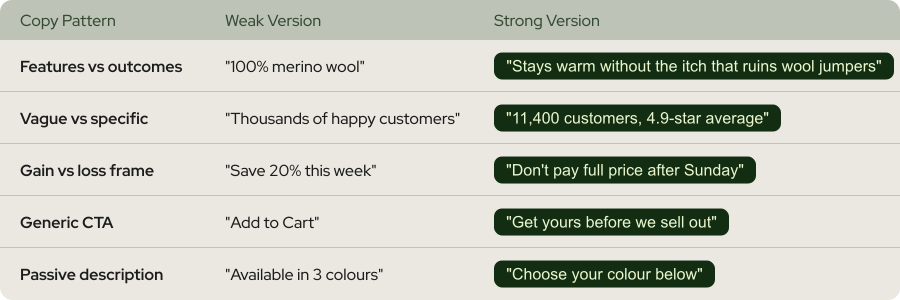
Think of it like two different conversations. The first goes: "This mattress has 2,000 individual pocket springs and a medium-firm tension rating." The second goes: "Wake up without the back pain you've learned to live with." The first speaks to the rational brain. The second triggers a desire in the emotional brain - and it is the emotional brain that reaches for the credit card.
The framing effect is particularly powerful in product page copywriting psychology. How information is presented changes how it is perceived, even when the underlying fact is identical. "Reduces returns by 40%" frames the same information as "40% fewer customers came back disappointed" - but the second version activates loss aversion in the reader in a way the first does not. Price framing works the same way: "$2 per day" and "$730 per year" are the same cost, but they trigger completely different emotional responses.
Concrete specificity builds credibility in a way that superlatives cannot. "Trusted by thousands of customers" triggers mild, vague positive feeling. "8,413 customers rated this 4.8 stars" triggers a specific, data-anchored trust response. Numbers do this because they signal evidence. The brain interprets precise numbers as the product of actual measurement, while round numbers are unconsciously read as estimates.
The Commitment Sequence: Designing for the Final Click
This anxiety is not irrational. It is the brain doing a last-pass risk assessment. "What if it doesn't fit? What if the quality is poor? What if I can't return it? What if I'm making a mistake?" Every one of these questions is a conversion barrier, and they all appear in the final moment before the click.
The commitment sequence reduces this anxiety through progressive micro-commitments. When a visitor selects a variant - choosing their size, their colour, their bundle - they have made a small commitment. A small commitment makes the next commitment (adding to cart) cognitively easier. This is the foot-in-the-door principle: each small yes makes the next yes more likely.
Worth a Read


 Any questions? Let’s chat
Do you have any questions left?
Here are the answers for you
High-converting product pages manage a 4-stage mental sequence every buyer runs automatically: a 3-second threat scan for basic safety, a relevance check for "is this for me?", a trust audit where social proof does heavy lifting, and a final loss calculation where the pain of buying is weighed against the pain of missing out. Pages designed around this sequence convert 2-3x higher than pages designed around features and layout alone, because they match how brains actually commit to purchase rather than how marketers imagine they should.
The most powerful psychological triggers product pages can use are social proof (reviews, purchase counts, ratings), loss aversion (guarantees, free returns, money-back policies), anchoring (showing original vs. sale price), and honest scarcity (real stock levels or time-bound offers). Avoid fake urgency and manufactured scarcity - buyers have developed strong radar for dishonest signals, and getting caught faking them destroys long-term trust.
Yes, and the data is overwhelming. Products with 5 or more reviews get 270% higher purchase rates, and 95% of shoppers read reviews before buying. But there's nuance - pages with only 5-star reviews trigger suspicion, while a realistic mix including some 3-star reviews reads as authentic and often converts better than "perfect" rating pages.
The four mental stages - threat scan, relevance check, trust audit, loss calculation - apply to every ecommerce purchase regardless of niche. What changes is the specific signals that satisfy each stage. A luxury watch buyer runs the same sequence as a protein powder buyer, but the trust signals (heritage, craftsmanship, certifications) look very different from the trust signals for supplements (third-party testing, ingredient sourcing, reviews).
You don't need urgency and scarcity to convert, but you do need to manage the loss calculation one way or another. Free shipping, generous return windows, and money-back guarantees cancel out loss aversion just as effectively as honest scarcity flips it. If you can't run honest scarcity (most brands can't), double down on risk reversal instead.
Psychology-driven product page changes typically show measurable conversion rate impact within 2-4 weeks of launch, assuming sufficient traffic to reach statistical significance. If you need help auditing which of the four stages your pages are failing at and running proper A/B tests to prove the lift, get a free CRO audit from Weblics - we've added $6.5M+ in measurable revenue for DTC brands by engineering pages around buyer psychology instead of guessing.
Every plan includes complete care-driven CRO - what varies is testing capacity and analysis depth.
All Plans Include:
Onboarding (First 5 days):
- Founder interviews & business deep-dive
- Comprehensive technical website audit
- Customer psychology analysis (ICP, 5 WHYs, SWOT)
- AI-trained buyer personas creation
- Ad creatives audit
- Marketing ecosystem review
Ongoing (Continuous):
- Psychology-first hypothesis generation
- Conversion-focused UX/UI design
- Strategic copywriting
- Shopify development & implementation
- A/B testing & QA
- Transparent reporting & documentation
- Strategy meetings (weekly or bi-weekly)
What Changes by Tier:
- Tests per month: 2, 4, 6, or 8 A/B tests
- Meeting frequency: Bi-weekly (Starter) or Weekly (Growth+)
- Analysis depth: Post-purchase surveys, support analysis, inventory strategy, KPI planning, quarterly planning (varies by tier)
Bonus (Growth+): Comprehensive email marketing audit from specialist partners
Flexible plans give you complete control over costs. You pay for the essential CRO work - strategy, hypothesis generation, analysis, A/B test and project management - whilst design, development, and QA are billed separately at $70/hourly only when you need them.
This is perfect if you have an in-house design or development team, or if you want to manage exactly what gets built and when. You're not locked into paying for services you don't need.
Scale plans include everything - strategy, analysis, design, development, QA, and implementation - in one predictable monthly retainer. No surprises, no separate invoices, just complete care-driven CRO delivered autonomously.
Choose Flexible if: You have internal resources or want precise cost control
Choose Scale if: You want fully autonomous, hands-off CRO with everything included
Transparent pricing based on your monthly traffic.
We charge based on traffic volume because testing capacity and statistical significance directly correlate with session count. The more traffic you have, the faster we can run tests and deliver results.
Pricing:
- Starter (50K-75K sessions): $1,650/mo - 2 tests
- Growth (75K-150K sessions): $3,500/mo - 4 tests
- Scale (150K-350K sessions): $6,600/mo - 6 tests
- Enterprise (350K+ sessions): $10,700/mo - 8 tests
No long-term contracts. Cancel anytime.
Every plan includes our 30-day profitability guarantee.
Not sure which plan fits?
Book a discovery call - I'll help you find the perfect match for your business.
Our battle-tested frameworks and systems validate every hypothesis before we build.
Phase 1: Onboarding (First 5 days)
- Deep-dive into your business, customers, and psychology
- Comprehensive technical audit
- 25+ care-driven optimisation hypotheses
- Custom roadmap delivered
Phase 2: Operational (Continuous)
- Validate hypotheses through AI-trained buyer personas
- Ask: "Does this genuinely serve customer needs - not manipulate?"
- Design, develop, and implement winning tests
- Rigorous QA across all devices
- Launch and monitor
Phase 3: Ongoing Analysis (Monthly)
- Behavioural segmentation & data analysis
- Post-purchase survey analysis (Growth+ plans)
- Support ticket insights analysis (Growth+ plans)
- Inventory strategy (Growth+ plans)
- Monthly KPI planning (Growth+ plans)
- Quarterly strategic planning (Scale+ plans)
Yes - but as an addition to our battle-tested frameworks, not the foundation.
We've built a proprietary AI system that validates every hypothesis against your actual buyer personas before we build anything. This ensures we only create optimisations your customers will genuinely respond to.
How it works:
- Our frameworks identify conversion opportunities
- We generate psychology-first hypotheses
- AI-trained buyer personas validate each hypothesis
- We ask: "Does this genuinely serve customer needs—not manipulate?"
- Only validated hypotheses get built and tested
This approach achieves 84% test success rate vs 45% industry average - because we validate with your actual customers before building, not after.
AI enhances our care-driven methodology. It doesn't replace genuine customer understanding.
Simply upgrade to the next tier for more included tests and enhanced ongoing analysis.
We're completely flexible - scale up or down based on your business needs. No penalties, no long-term lock-ins.
Want to discuss expanding your plan? Your dedicated CRO manager can adjust your package anytime.
Yes. No long-term contracts. Cancel anytime.
We earn your business every single month through results - not by trapping you in contracts.
If we don't make you profitable within 30 days, you pay nothing more until we deliver. That's our guarantee.
Most clients stay because care-driven CRO compounds month after month - each winning test keeps generating revenue whilst new tests add even more. But you're never locked in.
We're confident our results will speak for themselves.
Zero micromanagement required. We operate completely autonomously.
We're an extension of your business - making decisions with your profit margins AND mission in mind, not billable hours.
Your involvement:
- Initial onboarding: 2-3 hours (interviews, strategy alignment)
- Weekly/bi-weekly meetings: 30-60 minutes (strategy updates, results review)
- Ad-hoc questions: Slack chat for quick questions
We handle everything else:
- Hypothesis generation
- Design and copywriting
- Development and implementation
- QA across all devices
- A/B test management
- Data analysis and reporting
You focus on running your business. We focus on adding $50K+ monthly to your revenue.
That's the partnership.
We integrate with your existing tools—no forced changes.
Analytics: Shopify Analytics, Microsoft Clarity, GA4
Testing: Intelligems
Management: ClickUp, Figma, Slack
Your data stays in your systems. We integrate seamlessly.
We sign NDAs before any work begins. Your data is protected - always.
Security measures:
- Non-Disclosure Agreement (NDA) signed upfront
- Limited access permissions (only what's necessary)
- Data stored in your systems (we don't migrate your data)
- Team access restricted to assigned personnel only
- Regular security audits
We treat your business like our own - that includes protecting your data like it's our own.
You maintain full control over all access permissions and can revoke them anytime.
Guaranteed profitability in 30 days. $50K+ monthly revenue boost within 60 days.
Tangible outcomes:
But more than numbers - you'll understand your customers deeply, remove friction authentically, and build genuine relationships that compound revenue month after month.
- Increased conversion rates (50-100%+ improvements common)
- Higher average order values
- Improved ROAS (return on ad spend)
- Enhanced customer lifetime value
- Sustainable, compounding revenue growth
Our 84% hypothesis success rate means tests consistently work.
Real client results:
- ForKeeps Merch: $2.3M added revenue (+70% conversion rate)
- Organic Muscle: 128% conversion rate increase
- CKitchen: $1.1M added revenue over 22 months
- Mayven Studios: 50% conversion increase in 2 months
For as long as care-driven CRO continues delivering massive ROI - which typically compounds over 6+ months.
Why long-term partnerships work:
- Each winning test keeps generating revenue permanently
- New tests stack on top of previous wins
- Deeper customer understanding leads to better hypotheses
- Compounding effects multiply over time
Typical timeline:
- Months 1-3: Foundation + initial wins ($50K+ monthly added)
- Months 4-6: Compounding effects visible (wins multiply)
- Months 7-12: Sustainable growth system established
- 12+ months: Category-leading conversion rates achieved
Most clients stay 12-24+ months because results compound. But there's no lock-in - cancel anytime.
We earn your business every month through genuine results, not contracts.
Three simple steps:
Step 1: Book a Discovery Call 30-minute conversation to discuss your traffic, goals, and biggest challenges. We'll explore if we're a good fit and map out your path to $50K+ monthly revenue growth.
Step 2: Get Your Free Audit We'll conduct a comprehensive CRO audit of your website, deliver 25+ psychology-first hypotheses, and show you exactly where your biggest revenue opportunities are.
Step 3: Choose Your Plan & Launch Select the plan that fits your traffic and business needs. We'll onboard you within 5 days and have your first A/B test live within 10 days.
Ready to grow with care-driven CRO?
Or have more questions? Email us: garyk@weblics.agency

Spending more on

Getting less back?
Your ads aren't broken. The store they land on is.
Send us your URL and we'll show you which leaks are eating your ad spend, and which one to fix first.

Just honest findings on your store, within 48h.