


Why an 8-Figure Shopify Store Can Be Less Profitable Than a 7-Figure One in 2026
A brand doing $10M in revenue with a 4% net margin takes home $400K. A brand doing $3M with a 16% net margin takes home $480K. The second brand is smaller and richer. This is the paradox hiding inside most Shopify dashboards right now - and it starts with knowing your real numbers, not the ones that feel comfortable to look at.
- What Are Healthy Shopify Profit Margins in 2026?
- Shopify Gross Margin Benchmarks by Industry
- The Unit Economics Framework Every Shopify Brand Needs
- Where Shopify Margin Actually Leaks: The Four Culprits
- How to Improve Shopify Profitability Through COGS Optimisation
- CAC, LTV, and the Ratio That Determines Your Future
- How to Increase Ecommerce Margins Without Burning Customer Trust
What Are Healthy Shopify Profit Margins in 2026?
Here is the clearest way to think about it: gross margin tells you how profitable your product is before the chaos of running a business kicks in. Net margin tells you what actually stays in your pocket after ads, shipping, Shopify fees, returns, staff, and every app subscription you forgot you signed up for.
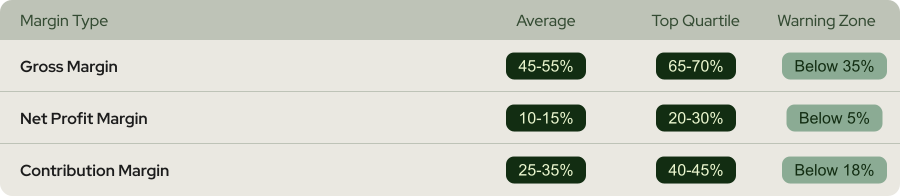
Based on data from TrueProfit's analysis of over 5,000 ecommerce stores (January 2025 - January 2026), the current picture looks like this:
Shopify Gross Margin Benchmarks by Industry
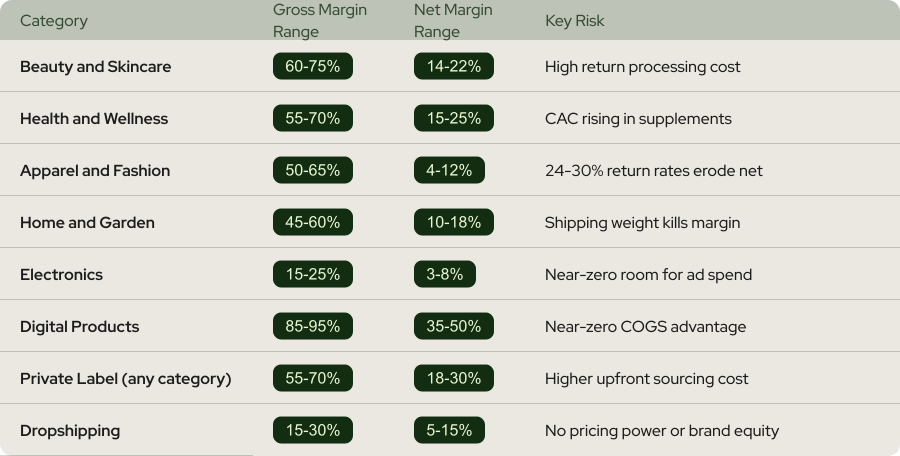
Here is how gross margin breaks down by category in 2026, drawn from current datasets:
The Unit Economics Framework Every Shopify Brand Needs
The Three Margin Layers You Must Track
The three layers every store must track monthly are:
Layer 1 - Gross Margin measures product-level profitability. Formula: (Revenue - COGS) / Revenue x 100. On a $50 product that costs $17.50 to source, your gross margin is 65%.
Layer 2 - Contribution Margin goes deeper. It subtracts all variable order costs - COGS, shipping, transaction fees, packaging, returns allocation - to show your true per-order profit before fixed overhead. On that same $50 order, once you subtract $17.50 COGS, $6 shipping, $1.75 payment processing, and $1 packaging, your contribution margin is 47.5%, not 65%.
Layer 3 - Net Margin is the bottom line after everything: fixed costs, ad spend, Shopify subscription, app fees, staff. This is the number that determines whether you are building a business or a very busy charity.
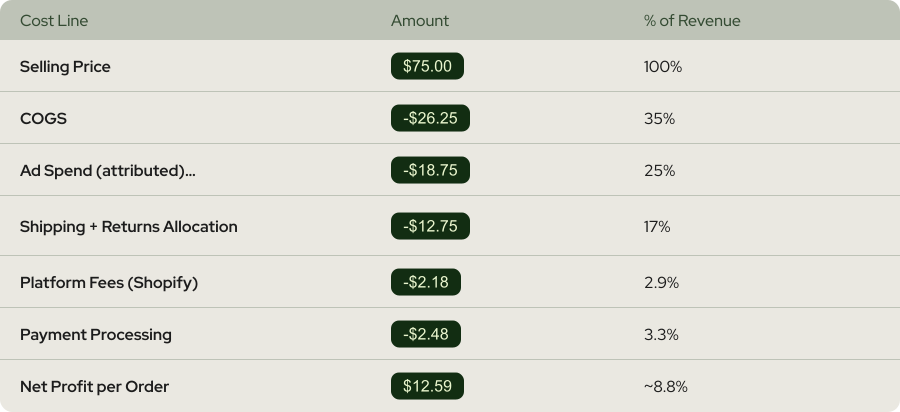
The Real Unit Economics of a $75 DTC Order
Where Shopify Margin Actually Leaks: The Four Culprits
Culprit 1 - Ad Spend Without Full Attribution. DTC brands currently spend 20-35% of revenue on paid advertising. Yet most measure ROAS at the campaign level, not at the full P&L level. ROAS of 3.5x sounds healthy until you account for returns, chargebacks, and fulfilment. Blended true ROAS - after all those deductions - is typically 18-30% lower than what your ads dashboard reports.
Culprit 2 - Returns That Go Unmeasured. The average DTC site sees a 14.2% return rate overall. Apparel brands face 25%+ consistently. Yet most Shopify analytics tools report revenue before returns are processed, giving you a number that overstates actual income by that margin. Processing a return costs $8-12 in return shipping, $5-8 for inspection, and $2-4 for restocking - before you factor in the lost sale.
Culprit 3 - App Subscription Creep. The average Shopify store runs 6-8 apps at $10-50 per month each. That is $200-500/month before you have hired a single person or made a single sale. Quarterly app audits are not optional for margin-conscious brands - they are a basic hygiene practice.
Culprit 4 - COGS Confusion. Most Shopify brands overestimate their margins by 5-8 percentage points because they only count product cost in COGS, excluding packaging, inspection, inbound shipping from suppliers, and quality failures. Real landed cost almost always exceeds what the invoice says.
How to Improve Shopify Profitability Through COGS Optimisation
Think of COGS like a fixed tax on each product you sell. Negotiating it down is the equivalent of giving yourself a tax cut that applies to every unit for the rest of the year.
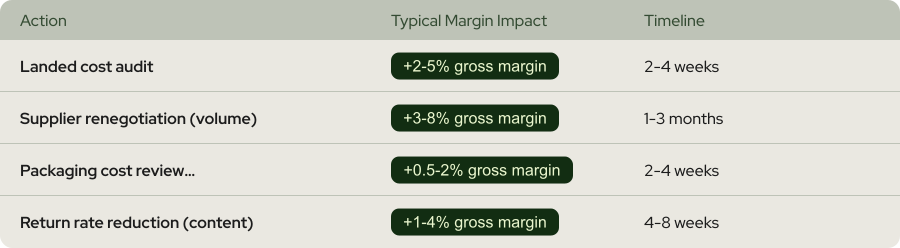
Here is where to start:
1. Audit your real landed cost. Add your product unit cost, inbound freight (as a per-unit allocation), customs duties, quality inspection fees, and supplier packaging. Most merchants are 8-12% off from their actual COGS because they only use the purchase order price.
2. Negotiate MOQ tiers. If you are ordering at a fixed quantity, request a tiered pricing schedule from your supplier showing costs at 1.5x and 2x your current volume. The savings at the next tier often justify a slightly higher inventory position.
3. Review packaging costs separately. Custom packaging is a brand builder, but it can add $0.50-2.50 per unit without being tracked as part of COGS. Map it explicitly and test whether unboxing experience lift in review scores and repeat purchases justifies the cost.
4. Reduce return-driven COGS waste. Every returned item that cannot be resold at full price is a COGS write-off. Better product photography, accurate sizing guides, and detailed descriptions can reduce apparel return rates by 4-8 percentage points, which directly restores gross margin.
CAC, LTV, and the Ratio That Determines Your Future
What a Healthy LTV:CAC Ratio Looks Like in 2026
A ratio of 3:1 is the minimum healthy benchmark - meaning for every $1 spent acquiring a customer, you generate $3 in lifetime profit. Premium DTC brands with strong retention and higher AOV reach 4-6:1. If your ratio sits below 2:1, you are effectively paying to have customers - your paid acquisition is not recovering its cost before those customers churn.
Average DTC customer acquisition costs sit between $45-70, with significant variation by vertical: pet products average $23, beauty $42, food $51, and supplements $89. With CAC having risen 222% over the past eight years, brands that rely entirely on paid acquisition are running a structural margin problem, not a temporary one.
Using Contribution Margin to Calculate Real CAC Payback
To calculate meaningful LTV, you need three inputs: average order value, average purchase frequency per year, and average customer lifespan (in years). Multiply those together, apply your gross margin percentage, and you have your margin-adjusted LTV - the number that should drive your CAC ceiling, not the revenue-based LTV figure most tools report by default.
How to Increase Ecommerce Margins Without Burning Customer Trust
Pricing architecture is the most underleveraged lever. A 1% price increase flows almost entirely to net margin - no incremental fulfilment cost, no extra ad spend. Yet most DTC brands price on cost-plus instinct rather than value-based research. Testing a 5-8% price increase on your top 20% of SKUs, using Shopify's native A/B pricing tools or a dedicated testing platform, almost always shows that conversion rates hold within a few percentage points while margin impact is significant.
Channel mix is a margin decision as much as a growth decision. DTC through Shopify yields the highest per-unit net margin at 8-15%, carrying the full CAC burden but keeping the full price. Wholesale reduces margin per unit but eliminates CAC and creates predictable cash flow. The brands with the healthiest margins in 2026 have a deliberate channel mix strategy - they are not in every channel, they are in the right channels for their cost structure.
AOV growth protects margin per customer acquired. When your AOV rises by $10 without adding fulfilment complexity, the incremental margin on that $10 is almost entirely gross profit, since you have already paid the CAC and the base fulfilment cost. Bundles, volume discounts with minimum thresholds, and post-purchase upsells all lift AOV at conversion rates that carry 40-60% gross margins, since there is no acquisition cost attached.
Retention investment is the highest-ROI margin lever available to Shopify brands right now. Email and SMS reach existing customers at near-zero incremental cost - roughly $0.001-0.005 per email sent, versus $5-15+ to reach the same person through a paid ad. Brands that build owned channel audiences of 10,000+ engaged subscribers consistently generate $10,000-20,000/month in revenue at contribution margins that look nothing like their paid acquisition economics.
If you work with a CRO agency like Weblics, the margin conversation is usually where the most impactful work begins. Improving your site conversion rate by 0.5 percentage points lowers your effective CAC on every channel simultaneously - making every other margin lever work harder without changing a single cost line.
Worth a Read



 Any questions? Let’s chat
Do you have any questions left?
Here are the answers for you
The average Shopify store net profit margin in 2026 sits between 10-15%, with the top quartile of stores reaching 20-30%. Gross margins typically range from 45-55% for product-based stores, with health and beauty and digital products at the high end and electronics at the low end. The key nuance is that "average" means very little if you are not comparing yourself to stores in your specific niche and at your revenue scale.
A good gross margin depends heavily on your category. Beauty and skincare brands target 60-75%, health and wellness 55-70%, and apparel 50-65% - but apparel net margins compress significantly due to high return rates. Electronics stores typically achieve only 15-25% gross margin, which leaves almost no room for ad spend. Use these category ranges as your benchmark, not the blended ecommerce average of 45%.
This usually comes down to timing and hidden costs. Revenue is recorded when the sale happens, but returns, chargebacks, and supplier payments hit your cash account on a delay. Most Shopify brands also undercount their true COGS by 8-12% because they exclude landed costs, packaging, and quality inspection fees. Run a proper contribution margin calculation on your last 90 days to see your real per-order profit.
No - and this is one of the most common and expensive misconceptions in DTC. Scaling revenue through paid ads can actually compress margins if CAC is rising faster than AOV or LTV is growing. Many 8-figure stores are less profitable than smaller 7-figure stores because their operational complexity and ad spend have grown faster than their margin. Revenue growth improves margins only when it is driven by improving unit economics, not just more spend.
Gross margin only subtracts COGS (the direct product cost) from revenue. Contribution margin goes one layer deeper, subtracting all variable order costs: COGS, shipping, transaction fees, packaging, and returns allocation. This gives you the true per-order profit before fixed costs. For a $50 product with a 65% gross margin, the contribution margin after variable costs might be 45-50% - and that is the number that actually tells you whether each sale is worth making.
A CRO audit improves margins in two ways at once. First, a higher conversion rate means more revenue from the same ad spend - which directly lowers your effective CAC across every channel. Second, UX improvements that reduce friction often lift AOV by steering customers toward bundles or higher-value options. At Weblics, our CRO audits typically identify 3-6 fixable margin leaks in the first 30 days, from checkout abandonment to underperforming product page layouts that suppress AOV.
Every plan includes complete care-driven CRO - what varies is testing capacity and analysis depth.
All Plans Include:
Onboarding (First 5 days):
- Founder interviews & business deep-dive
- Comprehensive technical website audit
- Customer psychology analysis (ICP, 5 WHYs, SWOT)
- AI-trained buyer personas creation
- Ad creatives audit
- Marketing ecosystem review
Ongoing (Continuous):
- Psychology-first hypothesis generation
- Conversion-focused UX/UI design
- Strategic copywriting
- Shopify development & implementation
- A/B testing & QA
- Transparent reporting & documentation
- Strategy meetings (weekly or bi-weekly)
What Changes by Tier:
- Tests per month: 2, 4, 6, or 8 A/B tests
- Meeting frequency: Bi-weekly (Starter) or Weekly (Growth+)
- Analysis depth: Post-purchase surveys, support analysis, inventory strategy, KPI planning, quarterly planning (varies by tier)
Bonus (Growth+): Comprehensive email marketing audit from specialist partners
Flexible plans give you complete control over costs. You pay for the essential CRO work - strategy, hypothesis generation, analysis, A/B test and project management - whilst design, development, and QA are billed separately at $70/hourly only when you need them.
This is perfect if you have an in-house design or development team, or if you want to manage exactly what gets built and when. You're not locked into paying for services you don't need.
Scale plans include everything - strategy, analysis, design, development, QA, and implementation - in one predictable monthly retainer. No surprises, no separate invoices, just complete care-driven CRO delivered autonomously.
Choose Flexible if: You have internal resources or want precise cost control
Choose Scale if: You want fully autonomous, hands-off CRO with everything included
Transparent pricing based on your monthly traffic.
We charge based on traffic volume because testing capacity and statistical significance directly correlate with session count. The more traffic you have, the faster we can run tests and deliver results.
Pricing:
- Starter (50K-75K sessions): $1,650/mo - 2 tests
- Growth (75K-150K sessions): $3,500/mo - 4 tests
- Scale (150K-350K sessions): $6,600/mo - 6 tests
- Enterprise (350K+ sessions): $10,700/mo - 8 tests
No long-term contracts. Cancel anytime.
Every plan includes our 30-day profitability guarantee.
Not sure which plan fits?
Book a discovery call - I'll help you find the perfect match for your business.
Our battle-tested frameworks and systems validate every hypothesis before we build.
Phase 1: Onboarding (First 5 days)
- Deep-dive into your business, customers, and psychology
- Comprehensive technical audit
- 25+ care-driven optimisation hypotheses
- Custom roadmap delivered
Phase 2: Operational (Continuous)
- Validate hypotheses through AI-trained buyer personas
- Ask: "Does this genuinely serve customer needs - not manipulate?"
- Design, develop, and implement winning tests
- Rigorous QA across all devices
- Launch and monitor
Phase 3: Ongoing Analysis (Monthly)
- Behavioural segmentation & data analysis
- Post-purchase survey analysis (Growth+ plans)
- Support ticket insights analysis (Growth+ plans)
- Inventory strategy (Growth+ plans)
- Monthly KPI planning (Growth+ plans)
- Quarterly strategic planning (Scale+ plans)
Yes - but as an addition to our battle-tested frameworks, not the foundation.
We've built a proprietary AI system that validates every hypothesis against your actual buyer personas before we build anything. This ensures we only create optimisations your customers will genuinely respond to.
How it works:
- Our frameworks identify conversion opportunities
- We generate psychology-first hypotheses
- AI-trained buyer personas validate each hypothesis
- We ask: "Does this genuinely serve customer needs—not manipulate?"
- Only validated hypotheses get built and tested
This approach achieves 84% test success rate vs 45% industry average - because we validate with your actual customers before building, not after.
AI enhances our care-driven methodology. It doesn't replace genuine customer understanding.
Simply upgrade to the next tier for more included tests and enhanced ongoing analysis.
We're completely flexible - scale up or down based on your business needs. No penalties, no long-term lock-ins.
Want to discuss expanding your plan? Your dedicated CRO manager can adjust your package anytime.
Yes. No long-term contracts. Cancel anytime.
We earn your business every single month through results - not by trapping you in contracts.
If we don't make you profitable within 30 days, you pay nothing more until we deliver. That's our guarantee.
Most clients stay because care-driven CRO compounds month after month - each winning test keeps generating revenue whilst new tests add even more. But you're never locked in.
We're confident our results will speak for themselves.
Zero micromanagement required. We operate completely autonomously.
We're an extension of your business - making decisions with your profit margins AND mission in mind, not billable hours.
Your involvement:
- Initial onboarding: 2-3 hours (interviews, strategy alignment)
- Weekly/bi-weekly meetings: 30-60 minutes (strategy updates, results review)
- Ad-hoc questions: Slack chat for quick questions
We handle everything else:
- Hypothesis generation
- Design and copywriting
- Development and implementation
- QA across all devices
- A/B test management
- Data analysis and reporting
You focus on running your business. We focus on adding $50K+ monthly to your revenue.
That's the partnership.
We integrate with your existing tools—no forced changes.
Analytics: Shopify Analytics, Microsoft Clarity, GA4
Testing: Intelligems
Management: ClickUp, Figma, Slack
Your data stays in your systems. We integrate seamlessly.
We sign NDAs before any work begins. Your data is protected - always.
Security measures:
- Non-Disclosure Agreement (NDA) signed upfront
- Limited access permissions (only what's necessary)
- Data stored in your systems (we don't migrate your data)
- Team access restricted to assigned personnel only
- Regular security audits
We treat your business like our own - that includes protecting your data like it's our own.
You maintain full control over all access permissions and can revoke them anytime.
Guaranteed profitability in 30 days. $50K+ monthly revenue boost within 60 days.
Tangible outcomes:
But more than numbers - you'll understand your customers deeply, remove friction authentically, and build genuine relationships that compound revenue month after month.
- Increased conversion rates (50-100%+ improvements common)
- Higher average order values
- Improved ROAS (return on ad spend)
- Enhanced customer lifetime value
- Sustainable, compounding revenue growth
Our 84% hypothesis success rate means tests consistently work.
Real client results:
- ForKeeps Merch: $2.3M added revenue (+70% conversion rate)
- Organic Muscle: 128% conversion rate increase
- CKitchen: $1.1M added revenue over 22 months
- Mayven Studios: 50% conversion increase in 2 months
For as long as care-driven CRO continues delivering massive ROI - which typically compounds over 6+ months.
Why long-term partnerships work:
- Each winning test keeps generating revenue permanently
- New tests stack on top of previous wins
- Deeper customer understanding leads to better hypotheses
- Compounding effects multiply over time
Typical timeline:
- Months 1-3: Foundation + initial wins ($50K+ monthly added)
- Months 4-6: Compounding effects visible (wins multiply)
- Months 7-12: Sustainable growth system established
- 12+ months: Category-leading conversion rates achieved
Most clients stay 12-24+ months because results compound. But there's no lock-in - cancel anytime.
We earn your business every month through genuine results, not contracts.
Three simple steps:
Step 1: Book a Discovery Call 30-minute conversation to discuss your traffic, goals, and biggest challenges. We'll explore if we're a good fit and map out your path to $50K+ monthly revenue growth.
Step 2: Get Your Free Audit We'll conduct a comprehensive CRO audit of your website, deliver 25+ psychology-first hypotheses, and show you exactly where your biggest revenue opportunities are.
Step 3: Choose Your Plan & Launch Select the plan that fits your traffic and business needs. We'll onboard you within 5 days and have your first A/B test live within 10 days.
Ready to grow with care-driven CRO?
Or have more questions? Email us: garyk@weblics.agency

Spending more on

Getting less back?
Your ads aren't broken. The store they land on is.
Send us your URL and we'll show you which leaks are eating your ad spend, and which one to fix first.

Just honest findings on your store, within 48h.