


Why Your Shopify CAC Keeps Climbing Even When Ad Performance Looks Fine
- Why CAC and conversion rate are the same problem
- How to calculate your real cost per acquisition on Shopify
- The five highest-leverage CRO fixes that directly lower CAC
- How to use A/B testing to reduce ad spend over time
- Product page optimisation: the biggest CAC lever you are ignoring
- Checkout optimisation: where your CAC bleeds the most
- How to build a CRO roadmap that compounds results
Why CAC and Conversion Rate Are the Same Problem
Think of it like a leaky bucket. You are pouring water (ad spend) in from the top, watching the bucket slowly fill (revenue), and wondering why you need more water each month. CRO patches the holes. You do not need a bigger hose. You need a better bucket.
The data backs this up sharply. A store doing £500,000 a month at a 2% conversion rate needs roughly 25,000 visitors to hit that number. Lift the conversion rate to 3% and you hit the same revenue with 16,667 visitors — a 33% reduction in required traffic for identical output. Same ad budget. More customers. Lower CAC. That is the entire argument for CRO, compressed into one calculation.
How to Calculate Your Real Cost Per Acquisition on Shopify
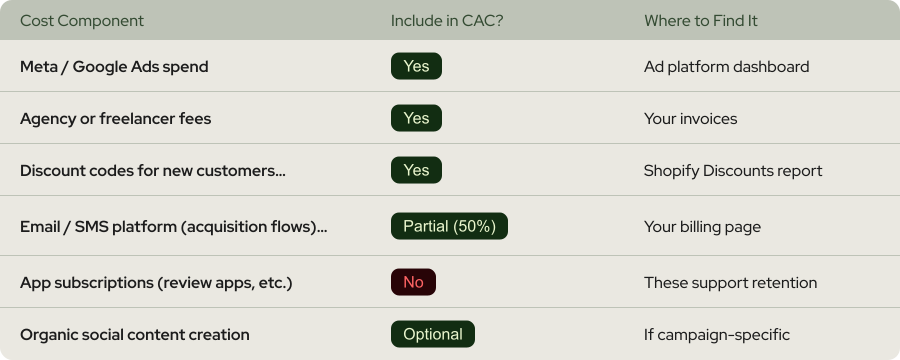
Your real cost per acquisition is not just ad spend divided by attributed conversions. It includes all the costs that turn a stranger into a customer: ad spend, agency or freelancer fees, app subscriptions tied to marketing, discount codes used as acquisition incentives, email and SMS platform costs, and the portion of your team time spent on acquisition activities. When you include these, the number is typically 20-40% higher than what Meta or Google Ads tells you.
The Simple Shopify CAC Formula
Real CAC = (Total Acquisition Spend in Period) / (New Customers Acquired in Period)
In Shopify Analytics, filter "Customers" by "First-time customers" to get the correct denominator. For total acquisition spend, pull your ad platform spend, add your agency retainer (prorated), and add the monthly cost of any acquisition-specific apps (post-purchase survey tools, landing page builders, referral software).
The Five Highest-Leverage CRO Fixes That Directly Lower CAC
1. Remove Friction From Your Primary Conversion Path
Map your primary conversion path from landing page to order confirmation. Count every click, every field, every decision point. Then ask: which of these does the customer actually need to do to buy? Anything that does not answer yes gets removed or deferred.
2. Fix Your Mobile Experience
Start with page speed. A one-second improvement in load time lifts conversions by up to 7%. On mobile, every second of delay raises your bounce probability by 32%. Check your Largest Contentful Paint (LCP) in Google PageSpeed Insights and target under 2.5 seconds.
3. Strengthen Your Product Page Trust Signals
Add review count and star rating above the fold. Include a returns policy summary within 2 scrolls of the Buy button. Add real user photos in the gallery, not just brand photography. These signals do not require A/B testing to justify — the data on social proof is consistent across thousands of ecommerce stores.
4. Reduce Cart Abandonment With Better Recovery
A three-email cart abandonment sequence (sent at 1 hour, 24 hours, and 72 hours) with personalised product imagery is the minimum. Add SMS recovery if your audience skews younger. For stores doing significant volume, an exit-intent pop-up with a soft offer (free shipping rather than a percentage discount — it is cheaper and converts nearly as well) keeps more carts from abandoning in the first place.
5. Optimise Your Landing Pages to Match Ad Intent
Create dedicated landing pages for your highest-spend ad campaigns. The headline on the landing page should echo the headline in the ad. The offer visible in the ad should appear above the fold on the landing page, immediately, without scrolling.
How to Use A/B Testing to Reduce Ad Spend Over Time
Think of A/B testing like renovating a restaurant. You do not close the whole kitchen at once — you change one thing, see if it improves service, and keep it if it does. Over time, you have an entirely better restaurant built from a series of low-risk, evidence-based decisions. Your competitors who renovated the whole kitchen in one go are still closed.
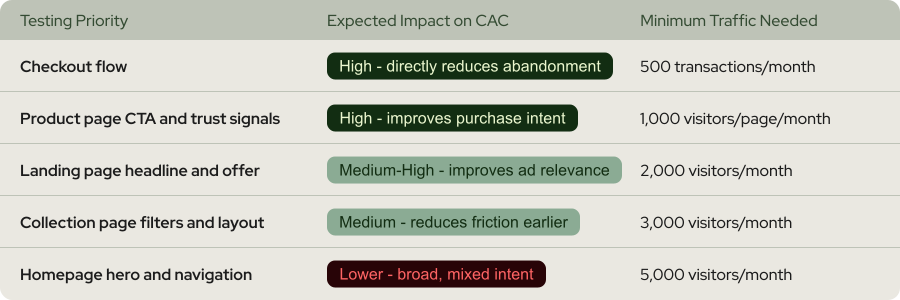
For a CRO testing programme focused on reducing CAC, prioritise experiments in this order: checkout flow, product page, collection pages, landing pages, homepage. The checkout and product page drive the most conversion volume, which means your tests reach statistical significance faster and your wins have the largest revenue impact.
Revenue-focused testing programmes can improve conversion performance by up to 40% while reducing wasted marketing spend by up to 50%. The compounding effect matters: a 0.5% monthly conversion lift does not add up to 6% annual growth — it compounds to 6.17%, because each improvement raises the baseline for the next one.
Product Page Optimisation - The Biggest CAC Lever You Are Ignoring
The customer arriving on your product page has already been qualified by your ad. They are interested. The question is whether your page resolves their remaining doubts before they hit the back button. Most pages fail at this, not because of bad design, but because of missing information at critical friction points.
The Product Page Elements That Move CAC Most
Your image gallery should include at least one lifestyle image showing the product in real use, not just on a white background. Real-world context builds emotional connection and reduces the "will this actually work for me?" hesitation. Add a size guide, dimensions, or a comparison visual if your product has sizing complexity.
Your copy should lead with the outcome, not the product. Instead of "Hand-poured soy wax candle, 8oz, 50-hour burn time," try "The candle that fills a room in 20 minutes and lasts 50 hours." Same information. Completely different conversion psychology.
Checkout Optimisation - Where Your CAC Bleeds the Most
Shopify's native checkout is already one of the highest-converting in ecommerce, but even the best defaults leave room for improvement. The biggest gains come from removing steps, adding reassurance, and offering the payment methods your customers actually use.
Shopify Checkout Changes That Reduce Cost Per Acquisition
Add trust badges immediately below the checkout button — "Secure Checkout", "256-bit SSL", and a money-back guarantee mark. These take a designer 30 minutes to add and collectively reduce checkout abandonment by 5-10% for stores that do not already have them visible.
Review the post-purchase flow. The thank-you page and confirmation email are underutilised assets for improving the LTV side of your CAC:LTV equation. An upsell on the confirmation page converts at 5-15% because the buyer is in maximum trust mode. Improving LTV has the same mathematical effect on your acquisition economics as reducing CAC.
How to Build a CRO Roadmap That Compounds Results
The compounding effect here is real. A store that improves its conversion rate by 0.2% each month ends the year with a meaningfully better unit economics position than it started with — and the improvements from month one are still in place, still working, when month twelve's test goes live.
Build your roadmap around this four-phase cycle: Audit (identify friction and opportunity), Hypothesise (prioritise tests by potential impact and ease of implementation), Test (run statistically sound A/B tests), Implement (roll out winners and document learnings). Repeat quarterly.
For Shopify stores spending under £20,000 per month on paid acquisition, start with the high-impact, low-effort wins: checkout trust signals, mobile page speed, and product page social proof. These can be implemented in days and typically show measurable CAC impact within 30-60 days.
For stores at higher spend levels, commission a full CRO audit before building a roadmap. A professional audit identifies which specific pages and funnel stages are losing the most conversions, so your testing budget goes to where the ROI is highest. The Weblics CRO audit process, for example, uses both quantitative data (heatmaps, session recordings, funnel analytics) and qualitative input (customer surveys, review mining) to build a prioritised hypothesis backlog — the result is a roadmap where every test has a strong evidence base before a single variant goes live.
Worth a Read


 Any questions? Let’s chat
Do you have any questions left?
Here are the answers for you
There is no universal number that applies across all Shopify stores — your CAC is only meaningful relative to your customer lifetime value and your product category. That said, broad industry data puts average ecommerce CAC somewhere in the £60-£130 range depending on vertical, with fashion at the lower end and electronics significantly higher. The healthier benchmark to target is a CAC:LTV ratio of at least 1:3 — meaning every customer you acquire generates at least three times what you spent to win them. If your CAC exceeds one-third of your average LTV, you have a unit economics problem that more ad spend will only amplify.
Improving your conversion rate does both — and the two effects are mathematically linked. If you spend the same amount on ads but convert more of the traffic those ads send, you get more customers per pound spent. That is, by definition, a lower CAC. The revenue increase is a consequence of the same improvement. Think of it this way: your ad spend is buying visits, and your conversion rate is determining how many of those visits become customers. A higher conversion rate means the same visit-buying budget produces more customers, which is identical to spending less per customer.
Quick-win CRO changes — checkout trust badges, mobile speed fixes, above-the-fold copy improvements — can show measurable CAC impact within 30-60 days for stores with sufficient traffic. Structural A/B testing programmes take longer: you typically need 2-4 weeks per test to reach statistical significance, and a proper testing roadmap will run multiple sequential tests before you see the full compounding effect. Most Shopify stores running a systematic CRO programme start to see durable CAC reductions within 90 days of starting.
CRO becomes most powerful at higher traffic volumes because tests reach statistical significance faster and winning changes have a larger absolute impact. However, best-practice implementations — checkout optimisation, trust signal additions, mobile speed improvements — do not require A/B testing and can benefit stores at any traffic level. If you are spending any budget on paid acquisition and your store has not been professionally audited, there are almost certainly fixable issues costing you more per acquisition than necessary.
Yes — CRO directly improves ROAS on Shopify because ROAS is also a function of your conversion rate. ROAS = Revenue / Ad Spend. If your conversion rate improves, more of your ad traffic converts, which increases revenue without increasing spend. That improves ROAS by the same ratio as your conversion lift. A store that lifts its conversion rate from 2% to 3% — a 50% relative improvement — would expect to see a proportional improvement in ROAS, all else equal. This is why CRO and paid media should not be managed in separate silos: they are deeply interdependent.
A professional CRO audit analyses your full conversion funnel using quantitative data (Google Analytics / Shopify Analytics funnel data, heatmaps, scroll maps, session recordings) and qualitative input (customer surveys, live chat logs, review mining). The output is a prioritised list of hypotheses ranked by potential revenue impact. You likely need one if your conversion rate is below the top 20% for your category, if your CAC has risen year-over-year without a corresponding ad cost increase, or if you have never systematically analysed where traffic is dropping off in your funnel. Weblics offers a 30-day CRO audit with a no-results, no-pay guarantee for qualifying Shopify stores.
Every plan includes complete care-driven CRO - what varies is testing capacity and analysis depth.
All Plans Include:
Onboarding (First 5 days):
- Founder interviews & business deep-dive
- Comprehensive technical website audit
- Customer psychology analysis (ICP, 5 WHYs, SWOT)
- AI-trained buyer personas creation
- Ad creatives audit
- Marketing ecosystem review
Ongoing (Continuous):
- Psychology-first hypothesis generation
- Conversion-focused UX/UI design
- Strategic copywriting
- Shopify development & implementation
- A/B testing & QA
- Transparent reporting & documentation
- Strategy meetings (weekly or bi-weekly)
What Changes by Tier:
- Tests per month: 2, 4, 6, or 8 A/B tests
- Meeting frequency: Bi-weekly (Starter) or Weekly (Growth+)
- Analysis depth: Post-purchase surveys, support analysis, inventory strategy, KPI planning, quarterly planning (varies by tier)
Bonus (Growth+): Comprehensive email marketing audit from specialist partners
Flexible plans give you complete control over costs. You pay for the essential CRO work - strategy, hypothesis generation, analysis, A/B test and project management - whilst design, development, and QA are billed separately at $70/hourly only when you need them.
This is perfect if you have an in-house design or development team, or if you want to manage exactly what gets built and when. You're not locked into paying for services you don't need.
Scale plans include everything - strategy, analysis, design, development, QA, and implementation - in one predictable monthly retainer. No surprises, no separate invoices, just complete care-driven CRO delivered autonomously.
Choose Flexible if: You have internal resources or want precise cost control
Choose Scale if: You want fully autonomous, hands-off CRO with everything included
Transparent pricing based on your monthly traffic.
We charge based on traffic volume because testing capacity and statistical significance directly correlate with session count. The more traffic you have, the faster we can run tests and deliver results.
Pricing:
- Starter (50K-75K sessions): $1,650/mo - 2 tests
- Growth (75K-150K sessions): $3,500/mo - 4 tests
- Scale (150K-350K sessions): $6,600/mo - 6 tests
- Enterprise (350K+ sessions): $10,700/mo - 8 tests
No long-term contracts. Cancel anytime.
Every plan includes our 30-day profitability guarantee.
Not sure which plan fits?
Book a discovery call - I'll help you find the perfect match for your business.
Our battle-tested frameworks and systems validate every hypothesis before we build.
Phase 1: Onboarding (First 5 days)
- Deep-dive into your business, customers, and psychology
- Comprehensive technical audit
- 25+ care-driven optimisation hypotheses
- Custom roadmap delivered
Phase 2: Operational (Continuous)
- Validate hypotheses through AI-trained buyer personas
- Ask: "Does this genuinely serve customer needs - not manipulate?"
- Design, develop, and implement winning tests
- Rigorous QA across all devices
- Launch and monitor
Phase 3: Ongoing Analysis (Monthly)
- Behavioural segmentation & data analysis
- Post-purchase survey analysis (Growth+ plans)
- Support ticket insights analysis (Growth+ plans)
- Inventory strategy (Growth+ plans)
- Monthly KPI planning (Growth+ plans)
- Quarterly strategic planning (Scale+ plans)
Yes - but as an addition to our battle-tested frameworks, not the foundation.
We've built a proprietary AI system that validates every hypothesis against your actual buyer personas before we build anything. This ensures we only create optimisations your customers will genuinely respond to.
How it works:
- Our frameworks identify conversion opportunities
- We generate psychology-first hypotheses
- AI-trained buyer personas validate each hypothesis
- We ask: "Does this genuinely serve customer needs—not manipulate?"
- Only validated hypotheses get built and tested
This approach achieves 84% test success rate vs 45% industry average - because we validate with your actual customers before building, not after.
AI enhances our care-driven methodology. It doesn't replace genuine customer understanding.
Simply upgrade to the next tier for more included tests and enhanced ongoing analysis.
We're completely flexible - scale up or down based on your business needs. No penalties, no long-term lock-ins.
Want to discuss expanding your plan? Your dedicated CRO manager can adjust your package anytime.
Yes. No long-term contracts. Cancel anytime.
We earn your business every single month through results - not by trapping you in contracts.
If we don't make you profitable within 30 days, you pay nothing more until we deliver. That's our guarantee.
Most clients stay because care-driven CRO compounds month after month - each winning test keeps generating revenue whilst new tests add even more. But you're never locked in.
We're confident our results will speak for themselves.
Zero micromanagement required. We operate completely autonomously.
We're an extension of your business - making decisions with your profit margins AND mission in mind, not billable hours.
Your involvement:
- Initial onboarding: 2-3 hours (interviews, strategy alignment)
- Weekly/bi-weekly meetings: 30-60 minutes (strategy updates, results review)
- Ad-hoc questions: Slack chat for quick questions
We handle everything else:
- Hypothesis generation
- Design and copywriting
- Development and implementation
- QA across all devices
- A/B test management
- Data analysis and reporting
You focus on running your business. We focus on adding $50K+ monthly to your revenue.
That's the partnership.
We integrate with your existing tools—no forced changes.
Analytics: Shopify Analytics, Microsoft Clarity, GA4
Testing: Intelligems
Management: ClickUp, Figma, Slack
Your data stays in your systems. We integrate seamlessly.
We sign NDAs before any work begins. Your data is protected - always.
Security measures:
- Non-Disclosure Agreement (NDA) signed upfront
- Limited access permissions (only what's necessary)
- Data stored in your systems (we don't migrate your data)
- Team access restricted to assigned personnel only
- Regular security audits
We treat your business like our own - that includes protecting your data like it's our own.
You maintain full control over all access permissions and can revoke them anytime.
Guaranteed profitability in 30 days. $50K+ monthly revenue boost within 60 days.
Tangible outcomes:
But more than numbers - you'll understand your customers deeply, remove friction authentically, and build genuine relationships that compound revenue month after month.
- Increased conversion rates (50-100%+ improvements common)
- Higher average order values
- Improved ROAS (return on ad spend)
- Enhanced customer lifetime value
- Sustainable, compounding revenue growth
Our 84% hypothesis success rate means tests consistently work.
Real client results:
- ForKeeps Merch: $2.3M added revenue (+70% conversion rate)
- Organic Muscle: 128% conversion rate increase
- CKitchen: $1.1M added revenue over 22 months
- Mayven Studios: 50% conversion increase in 2 months
For as long as care-driven CRO continues delivering massive ROI - which typically compounds over 6+ months.
Why long-term partnerships work:
- Each winning test keeps generating revenue permanently
- New tests stack on top of previous wins
- Deeper customer understanding leads to better hypotheses
- Compounding effects multiply over time
Typical timeline:
- Months 1-3: Foundation + initial wins ($50K+ monthly added)
- Months 4-6: Compounding effects visible (wins multiply)
- Months 7-12: Sustainable growth system established
- 12+ months: Category-leading conversion rates achieved
Most clients stay 12-24+ months because results compound. But there's no lock-in - cancel anytime.
We earn your business every month through genuine results, not contracts.
Three simple steps:
Step 1: Book a Discovery Call 30-minute conversation to discuss your traffic, goals, and biggest challenges. We'll explore if we're a good fit and map out your path to $50K+ monthly revenue growth.
Step 2: Get Your Free Audit We'll conduct a comprehensive CRO audit of your website, deliver 25+ psychology-first hypotheses, and show you exactly where your biggest revenue opportunities are.
Step 3: Choose Your Plan & Launch Select the plan that fits your traffic and business needs. We'll onboard you within 5 days and have your first A/B test live within 10 days.
Ready to grow with care-driven CRO?
Or have more questions? Email us: garyk@weblics.agency

Spending more on

Getting less back?
Your ads aren't broken. The store they land on is.
Send us your URL and we'll show you which leaks are eating your ad spend, and which one to fix first.

Just honest findings on your store, within 48h.