


Why CRO vs Ad Spend Is the Wrong Question for Most Shopify Founders
- Why more ad spend hits a wall (and CRO does not)
- The conversion rate optimisation ROI nobody calculates properly
- Paid traffic vs conversion optimisation: the $100k/month case study
- How CRO actually helps reduce customer acquisition cost
- When buying more ads still makes sense
- Shopify CAC optimisation: the compounding playbook
- How to improve conversion rate instead of ads (where to start)
Why More Ad Spend Hits a Wall (And CRO Does Not)
Here is what the data says. Meta CPMs rose roughly 20% year-over-year across ecommerce in 2025, with some verticals like health and wellness jumping 38%. Google CPCs climbed roughly 13% in the same window. Meanwhile, the average ecommerce CAC now sits between $68 and $84 across categories - a 40% increase in just two years.
Why does this happen? Three reasons work together. The ad auction has more bidders than ever. Meta's newer algorithms prioritise creative diversity and conversion volume, which punishes fragmented or low-budget accounts. And privacy changes have made precise targeting harder, so your first impressions are less qualified than they were two years ago.
Think of paid traffic like a parking garage. The first few spots near the entrance are cheap and convenient. As the garage fills, you pay more for worse spots, further from the door. Eventually you are paying premium prices to park on the roof in the rain. Every extra dollar into paid ads gets you a worse spot.
Conversion rate optimisation works the opposite way. Each lift compounds across 100% of your traffic - including the traffic you already paid for. It is not a new line item. It is a multiplier applied to every visitor, forever. A 20% conversion rate lift does not just help this month's cohort. It helps every cohort after it, at no additional cost per visitor.
The Conversion Rate Optimisation ROI Nobody Calculates Properly
Ad ROI is a snapshot. You spent $10k, you got $30k in attributed revenue, your ROAS is 3. Simple. Linear. Disposable the moment you stop spending.
CRO ROI is a curve. A 0.5 percentage point lift on your conversion rate is not a one-month event - it is a permanent upgrade to the profitability of every visitor you will ever acquire. On a store doing 100,000 sessions per month at a $75 AOV, moving from 2.0% to 2.5% conversion adds $37,500 in monthly revenue. But the real number is the annualised compounding value across all future traffic.
Here is the formula that actually matters: (CR lift × monthly sessions × AOV × gross margin) × 12 months, minus your CRO investment.
Run that on realistic inputs and you will see why A/B testing and CRO audits pay back dramatically faster than buying more traffic in a saturated auction. The lift is applied to the visitors you already had, plus the ones you acquire going forward, plus the ones you will acquire after you stop running ads entirely.
This is what we mean by compounding ROI conversion optimisation. It is not a metaphor. It is just maths that most growth dashboards refuse to show you because they are built to justify ad spend line items, not permanent asset improvements.
Paid Traffic vs Conversion Optimisation: The $100k/Month Case Study
The setup:
- Monthly revenue: $100,000
- Monthly sessions: 125,000
- Current conversion rate: 2.0%
- AOV: $80
- Gross margin: 60%
- Monthly ad spend: $33,000 at 3.0 blended ROAS
- Contribution margin per order: $48 (before fulfilment and fixed costs)
Now compare two growth paths over the next quarter.
Path A: Increase ad budget by 20% Spend goes from $33,000 to $39,600. At current ROAS of 3.0, that should add $19,800 in revenue. But diminishing returns are real - realistically, blended ROAS drops to around 2.6 at higher spend because you are buying lower-intent traffic. Actual added revenue: roughly $17,200. Gross profit added: roughly $10,320. The extra $6,600 in ad spend produced $3,720 in net contribution before you even touch fixed costs.
Path B: Improve conversion rate by 0.5 percentage points (from 2.0% to 2.5%) Same 125,000 sessions, new conversion rate = 3,125 orders instead of 2,500. That is 625 extra orders at $80 AOV = $50,000 in added revenue per month. Gross profit added: $30,000 per month. Annualised: $360,000 - from zero incremental ad spend.

How CRO Actually Helps Reduce Customer Acquisition Cost
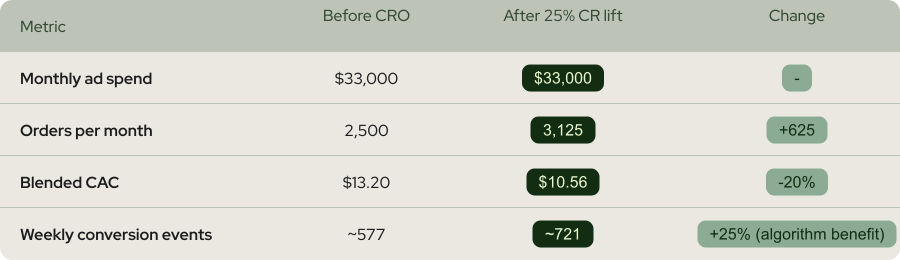
The maths is simple. If you are spending $33,000/month and acquiring 2,500 customers, your blended CAC is $13.20 per order. If you improve conversion rate by 25% without touching ad spend, you now acquire 3,125 customers at the same cost. Blended CAC drops to $10.56. That is a 20% Shopify CAC optimisation achieved with zero negotiation with the ad platforms.
Think of it like a taxi with an optimised route. You are paying the same fare, but you are getting to more destinations per trip. The meter does not change. The output does.
This is also why CRO is the most under-priced lever when Meta ads diminishing returns start to bite. When your CPMs rise 20% year-over-year, you can either absorb the hit, pull back spend, or make your site convert 20% better to offset it. Only one of those three options protects your growth rate.
There is also a second-order effect most founders miss. When conversion rate goes up, Meta's algorithm sees more conversion events per week. More conversion signal means better optimisation, lower CPA, and access to Meta's more sophisticated delivery models (which require 50+ conversions per ad set per week to learn properly). CRO indirectly lowers your ad CPA too. It is a loop.
When Buying More Ads Still Makes Sense
Buy more ads when your site is already converting above the top 20% threshold for your category and AOV. If you are at 4.5% with a $60 AOV, your conversion optimisation headroom is small and paid traffic becomes the main growth lever. CRO investments will still pay back, but the ROI gap narrows sharply.
Buy more ads when you are launching into a new market, a new product line, or a new geography. You need top-of-funnel volume to generate data. You cannot optimise a page with no traffic, and you cannot test offers with no sample size. Spend on traffic first, then layer CRO on top once you have statistical significance to work with.
Buy more ads when you have real LTV:CAC headroom. A 5:1 ratio often means you are under-investing in growth and leaving market share on the table. In that scenario, scaling paid spend - even at slightly diminished returns - is a sound financial decision as long as your payback period stays under 6 months.
The rule is boring but true: ads buy you visitors, CRO buys you customers. Stores under 2% conversion should fix conversion first. Stores over 4% can justifiably pour more into the top of the funnel. Everyone in between has a real choice to make, and the maths usually points to CRO.
Shopify CAC Optimisation: The Compounding Playbook
Step 1: Fix the foundation before scaling spend. A store converting below 2% has a leak, and pouring more water into a leaky bucket is just expensive hydration for the floor. Audit product pages, checkout flow, page speed, and mobile experience. These four areas contain roughly 80% of the conversion friction on most Shopify stores.
Step 2: Turn on the compounding loop. Every CR improvement you lock in makes your paid traffic more efficient, which lets you either scale spend profitably or reinvest the savings into retention and LTV. Higher LTV raises your max allowable CAC, which gives you more room to scale acquisition. Each cycle raises the ceiling.
Step 3: Treat CRO as a permanent function, not a project. The brands that compound the fastest run a continuous testing programme - typically one to two A/B tests per month on high-traffic pages. One lift per month at 5% average improvement compounds to roughly 80% more conversions over 12 months if the wins stick.
Step 4: Use ad spend for what it is good at - volume, data, and reach. Use CRO for what it is good at - efficiency, margin, and durability. Do not ask either one to do the other's job.
This is what ecommerce profit margin optimisation actually looks like in practice. Not a cost-cutting exercise. Not a pricing argument. Just a disciplined loop between acquiring visitors cheaply and converting them efficiently.
How to Improve Conversion Rate Instead of Ads (Where to Start)
Start with your product page. This is where roughly 40-60% of store visitors make the keep-browsing-or-leave decision. Audit your hero image, your above-the-fold copy, your social proof density, and your shipping information visibility. These four elements drive more conversion movement than almost anything else on the page.
Fix mobile. Mobile drives 65-78% of ecommerce traffic but converts at roughly half the desktop rate on most Shopify stores. Every 1-second improvement in mobile load time adds roughly 7% to conversion. On a $100k/month store, that is $7,000/month from a technical change that takes a week to ship.
Plug the cart abandonment leak. Average cart abandonment sits around 70% across ecommerce. If you are not running a proper 3-step abandoned cart email and SMS sequence, you are losing roughly 10-15% of already-paid-for customers every month. This is the single highest-ROI fix on most Shopify stores.
Run one A/B test per month on a high-traffic page. Not five. Not ten. One properly-designed, statistically-valid test that isolates a single hypothesis. Winners compound. Losers teach you something. Both are better than guessing.




Not Sure Where Your Store Is Leaking Revenue?
Get a free CRO or Google Ads audit from our team — we'll find what's killing your conversions and show you exactly how to fix it. No pitch, no pressure.
Get a free CRO or Google Ads audit from our team


Do you have any questions left?
Here are the answers for you
Ad spend buys you traffic, and the return ends when the budget ends. CRO improves the value of every visitor you acquire - including the ones you already paid for - and the return compounds across all future traffic. On a typical $100k/month Shopify store, a 0.5 percentage point conversion rate lift generates roughly 3x more annual gross profit than a 20% increase in ad budget, with a fraction of the ongoing cost.
No. Ads still buy you volume, data, and reach you cannot get anywhere else. The smart move is to fix your conversion rate first (especially if you are below 2%), then keep ad spend at a level where blended ROAS stays healthy while CRO makes each visitor more profitable. CRO and ads work together, not against each other.
Most Shopify stores sit well below the top 20% threshold of 3.2%. Moving from 2.0% to 2.5%-2.8% is a realistic 90-day outcome for a store that has not been systematically tested. Stores above 3.5% have smaller headroom but often see gains in AOV and LTV from the same optimisation work.
Partly, yes. A 20% CR improvement roughly offsets a 20% CPM increase in terms of blended CAC. But CRO cannot fix a broken offer or a margin problem, and it will not protect you forever if ad costs keep rising faster than your optimisation gains. CRO buys you breathing room and better unit economics while you work on bigger structural fixes like retention and LTV.
Ads produce results within days. CRO typically produces measurable lifts within 4-8 weeks per test, with the biggest wins usually landing in months 2-3 of a structured programme. The trade-off is speed versus durability - ads fade when you stop paying, CRO wins stay locked in.
You can absolutely run CRO in-house if you have a dedicated resource who knows statistical testing, Shopify theme customisation, and hypothesis prioritisation frameworks. Most founders do not have that bandwidth, which is why agencies exist. At Weblics, we run the entire CRO programme for Shopify brands spending $30k+ per month on ads, with a 30-day profitability guarantee - if we do not find enough opportunity to pay back the engagement, you do not pay.
Every plan includes complete care-driven CRO - what varies is testing capacity and analysis depth.
All Plans Include:
Onboarding (First 5 days):
- Founder interviews & business deep-dive
- Comprehensive technical website audit
- Customer psychology analysis (ICP, 5 WHYs, SWOT)
- AI-trained buyer personas creation
- Ad creatives audit
- Marketing ecosystem review
Ongoing (Continuous):
- Psychology-first hypothesis generation
- Conversion-focused UX/UI design
- Strategic copywriting
- Shopify development & implementation
- A/B testing & QA
- Transparent reporting & documentation
- Strategy meetings (weekly or bi-weekly)
What Changes by Tier:
- Tests per month: 2, 4, 6, or 8 A/B tests
- Meeting frequency: Bi-weekly (Starter) or Weekly (Growth+)
- Analysis depth: Post-purchase surveys, support analysis, inventory strategy, KPI planning, quarterly planning (varies by tier)
Bonus (Growth+): Comprehensive email marketing audit from specialist partners
Flexible plans give you complete control over costs. You pay for the essential CRO work - strategy, hypothesis generation, analysis, A/B test and project management - whilst design, development, and QA are billed separately at $70/hourly only when you need them.
This is perfect if you have an in-house design or development team, or if you want to manage exactly what gets built and when. You're not locked into paying for services you don't need.
Scale plans include everything - strategy, analysis, design, development, QA, and implementation - in one predictable monthly retainer. No surprises, no separate invoices, just complete care-driven CRO delivered autonomously.
Choose Flexible if: You have internal resources or want precise cost control
Choose Scale if: You want fully autonomous, hands-off CRO with everything included
Transparent pricing based on your monthly traffic.
We charge based on traffic volume because testing capacity and statistical significance directly correlate with session count. The more traffic you have, the faster we can run tests and deliver results.
Pricing:
- Starter (50K-75K sessions): $1,650/mo - 2 tests
- Growth (75K-150K sessions): $3,500/mo - 4 tests
- Scale (150K-350K sessions): $6,600/mo - 6 tests
- Enterprise (350K+ sessions): $10,700/mo - 8 tests
No long-term contracts. Cancel anytime.
Every plan includes our 30-day profitability guarantee.
Not sure which plan fits?
Book a discovery call - I'll help you find the perfect match for your business.
Our battle-tested frameworks and systems validate every hypothesis before we build.
Phase 1: Onboarding (First 5 days)
- Deep-dive into your business, customers, and psychology
- Comprehensive technical audit
- 25+ care-driven optimisation hypotheses
- Custom roadmap delivered
Phase 2: Operational (Continuous)
- Validate hypotheses through AI-trained buyer personas
- Ask: "Does this genuinely serve customer needs - not manipulate?"
- Design, develop, and implement winning tests
- Rigorous QA across all devices
- Launch and monitor
Phase 3: Ongoing Analysis (Monthly)
- Behavioural segmentation & data analysis
- Post-purchase survey analysis (Growth+ plans)
- Support ticket insights analysis (Growth+ plans)
- Inventory strategy (Growth+ plans)
- Monthly KPI planning (Growth+ plans)
- Quarterly strategic planning (Scale+ plans)
Yes - but as an addition to our battle-tested frameworks, not the foundation.
We've built a proprietary AI system that validates every hypothesis against your actual buyer personas before we build anything. This ensures we only create optimisations your customers will genuinely respond to.
How it works:
- Our frameworks identify conversion opportunities
- We generate psychology-first hypotheses
- AI-trained buyer personas validate each hypothesis
- We ask: "Does this genuinely serve customer needs—not manipulate?"
- Only validated hypotheses get built and tested
This approach achieves 84% test success rate vs 45% industry average - because we validate with your actual customers before building, not after.
AI enhances our care-driven methodology. It doesn't replace genuine customer understanding.
Simply upgrade to the next tier for more included tests and enhanced ongoing analysis.
We're completely flexible - scale up or down based on your business needs. No penalties, no long-term lock-ins.
Want to discuss expanding your plan? Your dedicated CRO manager can adjust your package anytime.
Yes. No long-term contracts. Cancel anytime.
We earn your business every single month through results - not by trapping you in contracts.
If we don't make you profitable within 30 days, you pay nothing more until we deliver. That's our guarantee.
Most clients stay because care-driven CRO compounds month after month - each winning test keeps generating revenue whilst new tests add even more. But you're never locked in.
We're confident our results will speak for themselves.
Zero micromanagement required. We operate completely autonomously.
We're an extension of your business - making decisions with your profit margins AND mission in mind, not billable hours.
Your involvement:
- Initial onboarding: 2-3 hours (interviews, strategy alignment)
- Weekly/bi-weekly meetings: 30-60 minutes (strategy updates, results review)
- Ad-hoc questions: Slack chat for quick questions
We handle everything else:
- Hypothesis generation
- Design and copywriting
- Development and implementation
- QA across all devices
- A/B test management
- Data analysis and reporting
You focus on running your business. We focus on adding $50K+ monthly to your revenue.
That's the partnership.
We integrate with your existing tools—no forced changes.
Analytics: Shopify Analytics, Microsoft Clarity, GA4
Testing: Intelligems
Management: ClickUp, Figma, Slack
Your data stays in your systems. We integrate seamlessly.
We sign NDAs before any work begins. Your data is protected - always.
Security measures:
- Non-Disclosure Agreement (NDA) signed upfront
- Limited access permissions (only what's necessary)
- Data stored in your systems (we don't migrate your data)
- Team access restricted to assigned personnel only
- Regular security audits
We treat your business like our own - that includes protecting your data like it's our own.
You maintain full control over all access permissions and can revoke them anytime.
Guaranteed profitability in 30 days. $50K+ monthly revenue boost within 60 days.
Tangible outcomes:
But more than numbers - you'll understand your customers deeply, remove friction authentically, and build genuine relationships that compound revenue month after month.
- Increased conversion rates (50-100%+ improvements common)
- Higher average order values
- Improved ROAS (return on ad spend)
- Enhanced customer lifetime value
- Sustainable, compounding revenue growth
Our 84% hypothesis success rate means tests consistently work.
Real client results:
- ForKeeps Merch: $2.3M added revenue (+70% conversion rate)
- Organic Muscle: 128% conversion rate increase
- CKitchen: $1.1M added revenue over 22 months
- Mayven Studios: 50% conversion increase in 2 months
For as long as care-driven CRO continues delivering massive ROI - which typically compounds over 6+ months.
Why long-term partnerships work:
- Each winning test keeps generating revenue permanently
- New tests stack on top of previous wins
- Deeper customer understanding leads to better hypotheses
- Compounding effects multiply over time
Typical timeline:
- Months 1-3: Foundation + initial wins ($50K+ monthly added)
- Months 4-6: Compounding effects visible (wins multiply)
- Months 7-12: Sustainable growth system established
- 12+ months: Category-leading conversion rates achieved
Most clients stay 12-24+ months because results compound. But there's no lock-in - cancel anytime.
We earn your business every month through genuine results, not contracts.
Three simple steps:
Step 1: Book a Discovery Call 30-minute conversation to discuss your traffic, goals, and biggest challenges. We'll explore if we're a good fit and map out your path to $50K+ monthly revenue growth.
Step 2: Get Your Free Audit We'll conduct a comprehensive CRO audit of your website, deliver 25+ psychology-first hypotheses, and show you exactly where your biggest revenue opportunities are.
Step 3: Choose Your Plan & Launch Select the plan that fits your traffic and business needs. We'll onboard you within 5 days and have your first A/B test live within 10 days.
Ready to grow with care-driven CRO?
Or have more questions? Email us: garyk@weblics.agency

Wait… Claim your free bonuses
Find out exactly where your store is leaking revenue — and where your ad spend is going to waste. No pitch, just data.
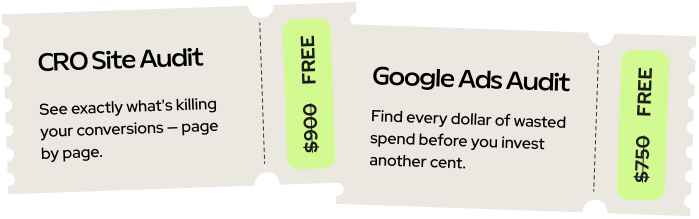
Just honest findings delivered within 2 business days.