


How to Measure CRO ROI Without Lying to Yourself
- The CRO ROI formula, in one line
- What inputs you need before you calculate anything
- Why most CRO revenue calculators lie to you
- The realistic win rate nobody wants to quote
- How to calculate uplift from conversion optimisation
- CRO payback period and cost per test, explained
- A worked example: projected revenue from CRO
The CRO ROI Formula, in One Line
That is it. Everything else is just honest inputs. Think of it like calculating the ROI on a new oven for a restaurant. You are not asking "how much does the oven cost." You are asking "how much extra food does it let me sell, minus what it costs to run, divided by what I paid for it." Same logic, different kitchen.
The trick is that the "projected annual uplift" variable hides a dozen smaller numbers. Your current conversion rate. Your average order value. Monthly sessions. How much lift you realistically expect per winning test. How often tests actually win. How many tests you plan to run. And whether you are counting compounded winners or treating each as a one-off.
Most agencies calculate ROI by plugging in a single 25% uplift assumption against 12 months of revenue and calling it a day. That is not a forecast, that is marketing. A real CRO ROI calculation discounts for tests that do not win, factors in the revenue floor that winners lock in permanently, and subtracts the fully-loaded cost of the programme, not just the agency invoice.
What Inputs You Need Before You Calculate Anything
Here are the inputs you need, and where to find each one:
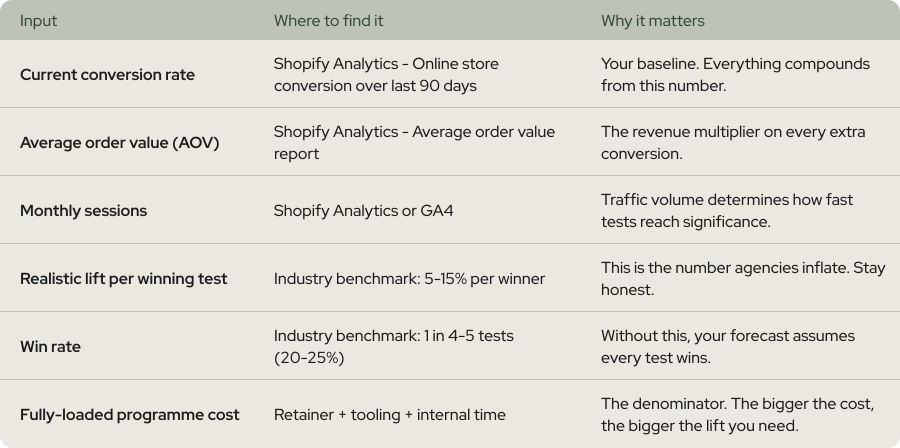
A quick reality check on the "realistic lift" input. According to the VWO Benchmark Report, winning A/B tests typically deliver between 5 and 15% conversion lift, not the 30-50% numbers vendor case studies like to advertise. If an agency is quoting you an "average 49% uplift," ask them to share their full test log, including the losers. They usually cannot.
Why Most CRO Revenue Calculators Lie to You
Here is the trick agencies use. They take your current revenue, multiply by a 25% uplift, and show you a massive number. What they do not show you is that 25% is the lift assuming every single test wins, with maximum impact, compounded immediately. In reality, about 1 in 4 to 1 in 5 tests produces a statistically significant winner. The rest are flat or losers. A proper CRO revenue calculator discounts aggressively for this.
Here is the honest version of the math. Say you plan to run 12 tests over the year. With a 25% win rate, you will ship roughly 3 winners. If each winner delivers a 10% lift on the element tested, and those elements compound across the funnel, your realistic annual lift is closer to 8-12% of baseline revenue, not 25%. That is a meaningful number, but it is not the fireworks show the pitch deck promised.
Think of it like fishing with a net. You cast the net 12 times, pull up something worth keeping maybe 3 of those times. The other 9 casts are not failures, they are data. They tell you where the fish are not. But if your forecast assumes every cast is a winner, you are going to be very disappointed at the dock.
The good news: the winners are permanent. A winning test does not expire when the next one ships. It locks in a revenue floor that compounds with every future winner on top of it. That is where the real ROI lives, and why CRO becomes more valuable the longer you run it.
The Realistic Win Rate Nobody Wants to Quote
That means for every 10 tests you run, expect 2 or 3 winners. Maybe 1-2 flat results. The rest are losers or inconclusive. If an agency tells you their win rate is 60% or higher, one of three things is true. They are running very easy tests on broken sites, they are calling tests at 70% confidence instead of 90-95%, or they are cherry-picking which tests they count.
Industry research backs this up. VWO's data shows most programmes land in the 20-30% range. Some sources, like Elevation Marketing's analysis, report that only one in eight A/B tests produces significant results - a harsher number that reflects programmes running more ambitious tests or facing higher false-discovery rates. The takeaway is consistent: most tests do not win, and that is normal.
This changes the A/B testing ROI calculation significantly. If you budget for 12 tests a year and assume every one wins, your forecast is 4-5x too optimistic. If you budget for 12 tests and assume 3 win, you get a much more grounded number, and one you can defend in front of a finance team.
The analogy I like here is baseball. A 0.300 batting average makes you an all-star. That means you fail 70% of the time and still get paid millions. CRO works the same way. The win rate is the floor you expect. The value is in running enough tests that the wins add up faster than the losses cost you.
How to Calculate Uplift from Conversion Optimisation
Break it down step by step:
1. Start with monthly sessions (say, 100,000) and multiply by your current conversion rate (2%) to get baseline orders (2,000/month).
2. Multiply baseline orders by AOV (£80) to get baseline monthly revenue (£160,000).
3. Now apply a realistic lift per winning test (10%) and discount by win rate (25%). That gives you an effective lift per test run of 2.5% (10% × 0.25).
4. Multiply baseline monthly revenue by 2.5% per test, then by tests shipped per year (12) to get your annual uplift projection.
Run the numbers: £160,000 × 2.5% × 12 = £48,000 in annual revenue uplift for the first year. That is not including the compounding effect, which stacks as later tests build on earlier winners.
Here is where it gets interesting. The 12 tests produce about 3 winners. Each winner permanently raises the baseline for everything that follows. So in Year 2, you are not starting from a 2% conversion rate, you are starting from roughly 2.1-2.2% depending on how clean the winners were. Run the same programme in Year 2 and your baseline revenue number is higher, so the same 2.5% effective lift per test delivers more absolute revenue.
CRO Payback Period and Cost Per Test, Explained
Your cost per test matters here more than the monthly retainer does. Most CRO agencies retainer between $3,000-$15,000 per month, with mid-tier ecommerce agencies typically in the $5,000-$10,000 range. Add $200-$1,500 for tooling (A/B testing platform, heatmaps, session recording), plus roughly 10-30 hours of developer time per test if not bundled into the retainer.
The CRO cost per test is your total monthly programme spend divided by the number of tests you actually ship per month. If you pay a $7,500 retainer and ship 2 tests per month, cost per test is $3,750. If you pay the same $7,500 and ship only 1 test per month, you are paying $7,500 per test, which is twice as expensive even though the invoice looks identical.
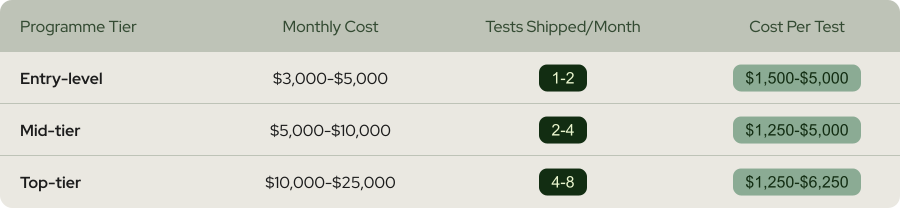
Think of it like installing solar panels. The upfront cost stings. The payback period feels long when you are writing the cheques. But once you hit payback, every extra month is close to pure profit. CRO works on the same curve, which is why brands that quit at month 3 almost always lose money, and brands that commit to 12+ months almost always win.
A Worked Example: Projected Revenue from CRO
The inputs:
-Monthly sessions: 150,000
-Current conversion rate: 1.8%
-AOV: £75
-Realistic lift per winning test: 10%
-Win rate: 25% (1 in 4 tests wins)
-Tests per year: 12
- Programme cost: $8,000/month retainer + $500/month tooling = $102,000/year (roughly £80,000)
The math:
-Baseline monthly orders: 150,000 × 1.8% = 2,700
-Baseline monthly revenue: 2,700 × £75 = £202,500
-Effective lift per test: 10% × 25% = 2.5%
-Annual revenue uplift (Year 1, no compounding): £202,500 × 2.5% × 12 = £60,750
-Annual uplift with modest compounding (assume 3 winners stack): approximately £75,000-£85,000
The ROI:
-Year 1 ROI: (£80,000 uplift - £80,000 cost) ÷ £80,000 = roughly breakeven to slight positive
-Year 2 ROI (new winners built on Year 1 floor): approximately 150-200% (because the baseline is now higher, but cost stays flat)
-Year 3 ROI: 250-400%+ as compounding accelerates
That is the honest picture. Year 1 is often near breakeven, sometimes slightly negative if win rate runs low. Year 2 is where CRO pays for itself clearly. Year 3 is where it becomes your most profitable marketing investment. This is why the CRO payback period matters so much: brands that pull the plug at month 6 are leaving the compounding years on the table.
Compare this to the alternative. £80,000 in paid ads buys you £80,000 in revenue, give or take. When the ads turn off, the revenue turns off. £80,000 in CRO buys you a revenue floor that stays raised, a data library about what your customers actually respond to, and compounding gains that grow every year the programme continues.
If you want to skip the spreadsheet work, our Shopify CRO audit process builds this exact calculation into your onboarding, with your real numbers and realistic assumptions. We will not hand you a 10x projection. We will hand you the math that actually holds up.
Worth a Read


 Any questions? Let’s chat
Do you have any questions left?
Here are the answers for you
For most Shopify brands, Year 1 CRO ROI lands between breakeven and 1.5x, not the 5-10x numbers agencies pitch. This is because winners compound slowly at first, and the real gains stack in Years 2 and 3. If you are evaluating a CRO investment on a 12-month window only, you are measuring it wrong. The honest ROI window is 24-36 months.
Use industry benchmarks for win rate (20-25%) and lift per winner (5-15%), then plug in your own traffic, conversion rate, and AOV. For a first-year estimate, assume conservative numbers: 20% win rate, 8% lift per winner. If the math still shows positive ROI over 24 months, the programme is worth running. If it does not, either your traffic is too low or your margins are too thin for CRO to pay off yet.
20-25% is the industry-honest range for ecommerce A/B testing win rates. Anything above 30% consistently means the agency is either running very easy tests or calling them too early. Anything below 15% means the hypothesis pipeline is weak. The goal is not to maximise win rate, it is to maximise cumulative revenue lift across all tests run.
No, and that is the point of honest CRO ROI calculation. Case studies are the winners agencies publish. They are a biased sample that excludes the 4 out of 5 tests that did not win. The typical winning test delivers 5-15% lift, not 49%. Plan around the median, not the marketing.
If you have under 5,000-10,000 monthly sessions on the pages you want to test, running statistically significant A/B tests is difficult. The honest answer is to focus on CRO research (heatmaps, surveys, usability tests) and direct UX fixes instead of full A/B testing, until your traffic grows. A good CRO partner will tell you this upfront instead of taking your money to run tests that cannot produce reliable results.
Build the ROI calculation with honest inputs (20-25% win rate, 8-12% lift per winner, fully-loaded cost) and present a 24-month forecast, not a 12-month one. Show the revenue floor compounding effect, and compare the 3-year ROI against paid ads or other marketing spend. CFOs push back on inflated numbers, not on math that holds up. If you want help building this case, book a free CRO audit with Weblics and we will run the calculation with your actual store data.
Every plan includes complete care-driven CRO - what varies is testing capacity and analysis depth.
All Plans Include:
Onboarding (First 5 days):
- Founder interviews & business deep-dive
- Comprehensive technical website audit
- Customer psychology analysis (ICP, 5 WHYs, SWOT)
- AI-trained buyer personas creation
- Ad creatives audit
- Marketing ecosystem review
Ongoing (Continuous):
- Psychology-first hypothesis generation
- Conversion-focused UX/UI design
- Strategic copywriting
- Shopify development & implementation
- A/B testing & QA
- Transparent reporting & documentation
- Strategy meetings (weekly or bi-weekly)
What Changes by Tier:
- Tests per month: 2, 4, 6, or 8 A/B tests
- Meeting frequency: Bi-weekly (Starter) or Weekly (Growth+)
- Analysis depth: Post-purchase surveys, support analysis, inventory strategy, KPI planning, quarterly planning (varies by tier)
Bonus (Growth+): Comprehensive email marketing audit from specialist partners
Flexible plans give you complete control over costs. You pay for the essential CRO work - strategy, hypothesis generation, analysis, A/B test and project management - whilst design, development, and QA are billed separately at $70/hourly only when you need them.
This is perfect if you have an in-house design or development team, or if you want to manage exactly what gets built and when. You're not locked into paying for services you don't need.
Scale plans include everything - strategy, analysis, design, development, QA, and implementation - in one predictable monthly retainer. No surprises, no separate invoices, just complete care-driven CRO delivered autonomously.
Choose Flexible if: You have internal resources or want precise cost control
Choose Scale if: You want fully autonomous, hands-off CRO with everything included
Transparent pricing based on your monthly traffic.
We charge based on traffic volume because testing capacity and statistical significance directly correlate with session count. The more traffic you have, the faster we can run tests and deliver results.
Pricing:
- Starter (50K-75K sessions): $1,650/mo - 2 tests
- Growth (75K-150K sessions): $3,500/mo - 4 tests
- Scale (150K-350K sessions): $6,600/mo - 6 tests
- Enterprise (350K+ sessions): $10,700/mo - 8 tests
No long-term contracts. Cancel anytime.
Every plan includes our 30-day profitability guarantee.
Not sure which plan fits?
Book a discovery call - I'll help you find the perfect match for your business.
Our battle-tested frameworks and systems validate every hypothesis before we build.
Phase 1: Onboarding (First 5 days)
- Deep-dive into your business, customers, and psychology
- Comprehensive technical audit
- 25+ care-driven optimisation hypotheses
- Custom roadmap delivered
Phase 2: Operational (Continuous)
- Validate hypotheses through AI-trained buyer personas
- Ask: "Does this genuinely serve customer needs - not manipulate?"
- Design, develop, and implement winning tests
- Rigorous QA across all devices
- Launch and monitor
Phase 3: Ongoing Analysis (Monthly)
- Behavioural segmentation & data analysis
- Post-purchase survey analysis (Growth+ plans)
- Support ticket insights analysis (Growth+ plans)
- Inventory strategy (Growth+ plans)
- Monthly KPI planning (Growth+ plans)
- Quarterly strategic planning (Scale+ plans)
Yes - but as an addition to our battle-tested frameworks, not the foundation.
We've built a proprietary AI system that validates every hypothesis against your actual buyer personas before we build anything. This ensures we only create optimisations your customers will genuinely respond to.
How it works:
- Our frameworks identify conversion opportunities
- We generate psychology-first hypotheses
- AI-trained buyer personas validate each hypothesis
- We ask: "Does this genuinely serve customer needs—not manipulate?"
- Only validated hypotheses get built and tested
This approach achieves 84% test success rate vs 45% industry average - because we validate with your actual customers before building, not after.
AI enhances our care-driven methodology. It doesn't replace genuine customer understanding.
Simply upgrade to the next tier for more included tests and enhanced ongoing analysis.
We're completely flexible - scale up or down based on your business needs. No penalties, no long-term lock-ins.
Want to discuss expanding your plan? Your dedicated CRO manager can adjust your package anytime.
Yes. No long-term contracts. Cancel anytime.
We earn your business every single month through results - not by trapping you in contracts.
If we don't make you profitable within 30 days, you pay nothing more until we deliver. That's our guarantee.
Most clients stay because care-driven CRO compounds month after month - each winning test keeps generating revenue whilst new tests add even more. But you're never locked in.
We're confident our results will speak for themselves.
Zero micromanagement required. We operate completely autonomously.
We're an extension of your business - making decisions with your profit margins AND mission in mind, not billable hours.
Your involvement:
- Initial onboarding: 2-3 hours (interviews, strategy alignment)
- Weekly/bi-weekly meetings: 30-60 minutes (strategy updates, results review)
- Ad-hoc questions: Slack chat for quick questions
We handle everything else:
- Hypothesis generation
- Design and copywriting
- Development and implementation
- QA across all devices
- A/B test management
- Data analysis and reporting
You focus on running your business. We focus on adding $50K+ monthly to your revenue.
That's the partnership.
We integrate with your existing tools—no forced changes.
Analytics: Shopify Analytics, Microsoft Clarity, GA4
Testing: Intelligems
Management: ClickUp, Figma, Slack
Your data stays in your systems. We integrate seamlessly.
We sign NDAs before any work begins. Your data is protected - always.
Security measures:
- Non-Disclosure Agreement (NDA) signed upfront
- Limited access permissions (only what's necessary)
- Data stored in your systems (we don't migrate your data)
- Team access restricted to assigned personnel only
- Regular security audits
We treat your business like our own - that includes protecting your data like it's our own.
You maintain full control over all access permissions and can revoke them anytime.
Guaranteed profitability in 30 days. $50K+ monthly revenue boost within 60 days.
Tangible outcomes:
But more than numbers - you'll understand your customers deeply, remove friction authentically, and build genuine relationships that compound revenue month after month.
- Increased conversion rates (50-100%+ improvements common)
- Higher average order values
- Improved ROAS (return on ad spend)
- Enhanced customer lifetime value
- Sustainable, compounding revenue growth
Our 84% hypothesis success rate means tests consistently work.
Real client results:
- ForKeeps Merch: $2.3M added revenue (+70% conversion rate)
- Organic Muscle: 128% conversion rate increase
- CKitchen: $1.1M added revenue over 22 months
- Mayven Studios: 50% conversion increase in 2 months
For as long as care-driven CRO continues delivering massive ROI - which typically compounds over 6+ months.
Why long-term partnerships work:
- Each winning test keeps generating revenue permanently
- New tests stack on top of previous wins
- Deeper customer understanding leads to better hypotheses
- Compounding effects multiply over time
Typical timeline:
- Months 1-3: Foundation + initial wins ($50K+ monthly added)
- Months 4-6: Compounding effects visible (wins multiply)
- Months 7-12: Sustainable growth system established
- 12+ months: Category-leading conversion rates achieved
Most clients stay 12-24+ months because results compound. But there's no lock-in - cancel anytime.
We earn your business every month through genuine results, not contracts.
Three simple steps:
Step 1: Book a Discovery Call 30-minute conversation to discuss your traffic, goals, and biggest challenges. We'll explore if we're a good fit and map out your path to $50K+ monthly revenue growth.
Step 2: Get Your Free Audit We'll conduct a comprehensive CRO audit of your website, deliver 25+ psychology-first hypotheses, and show you exactly where your biggest revenue opportunities are.
Step 3: Choose Your Plan & Launch Select the plan that fits your traffic and business needs. We'll onboard you within 5 days and have your first A/B test live within 10 days.
Ready to grow with care-driven CRO?
Or have more questions? Email us: garyk@weblics.agency

Spending more on

Getting less back?
Your ads aren't broken. The store they land on is.
Send us your URL and we'll show you which leaks are eating your ad spend, and which one to fix first.

Just honest findings on your store, within 48h.