


The mistake most founders make when hiring a Shopify CRO agency
You've probably already lived this: an agency comes in, runs an audit, presents a deck full of "quick wins," and hands you a prioritized list of recommendations. Then they ask for a monthly retainer to "support implementation." Three months later, your team is still the one writing the tickets, briefing the developer, and chasing the agency for the next update.
That's not a CRO agency. That's a consulting subscription with a Shopify logo on the deck.
The mistake isn't hiring outside help — it's hiring for recommendations instead of outcomes. Most agencies are structured to sell hours and hand off deliverables, not to own a hypothesis through design, development, QA, and a measured result. If the vendor you're evaluating can't tell you, in plain terms, who codes the test and who's on the hook when it loses, you're about to buy another PDF.
If your conversion rate is already sitting below what you'd expect for your traffic and you're not sure why, it helps to diagnose the problem before you even start agency conversations — see Shopify Conversion Rate Below Benchmark? Here's the Order to Fix Things In for a sequencing framework.
What CRO on Shopify actually means (and why 'audit' isn't the deliverable)
Conversion rate optimization (CRO) is the discipline of increasing the percentage of visitors who complete a purchase, using structured A/B testing rather than opinion. On Shopify specifically, that means testing changes to product pages, collection pages, cart, and checkout flow against a control, then keeping only the variant that wins.
The part that gets lost: an audit is not CRO. An audit is a diagnostic — it tells you where visitors are dropping off and, if it's done well, quantifies the dollar impact of each drop-off point. CRO is what happens after: forming a hypothesis, building the variant, running the test to statistical significance, and shipping the winner.
A lot of the store elements that get flagged in a generic audit — trust badges, variant pickers, shipping banners — look correct because they resemble what a competitor is doing. But copying a competitor's layout without testing it against your own customers' psychology is a guess, not an optimization. Your buyers aren't identical to theirs, and an element that lifted conversion on one store can just as easily suppress it on another. The only way to know is to test it on your own traffic.
The retainer-and-recommendations model, and why it stalls
Here's the pattern across most agencies selling "Shopify CRO services": audit, strategy call, prioritized roadmap, monthly retainer for implementation. It reads well in a proposal. In practice it creates three problems for a founder who's already stretched thin:
- You're paying for time, not outcomes. A retainer bills hours whether a test ships or not, and whether it wins or not.
- Implementation becomes your job again. Many agencies stop at strategy and expect your internal team — the one with no spare bandwidth — to brief developers and manage QA.
- There's no shared downside. If the agency's hypothesis loses, you've still paid the retainer. The financial risk sits entirely with you.
If you've already been burned by a vendor that promised a roadmap and delivered a Google Drive folder, you're not wrong to be skeptical of the next pitch — they mostly sound the same. The way to cut through that is to stop asking "what will you recommend" and start asking "what will you build, ship, and be accountable for."
The litmus test: fixed price per test, and you don't pay when it loses
There's a simple question that separates a real CRO partner from a recommendations vendor: what happens if the test loses?
Ask that question in the sales call. If the answer involves the words "retainer," "hours already billed," or "strategic learnings," you're looking at a vendor who gets paid regardless of outcome. That's the model most of the market runs on.
Weblics runs differently: fixed price per test, and on the risk-free tier, you only pay when a test wins. No retainer. No bloated hourly rate. If a hypothesis doesn't beat the control, you owe nothing for it. The incentive alignment is the entire point — the agency only gets paid when your conversion rate actually moves, not when a deck gets presented.
That structure only works if the agency also owns full-cycle delivery: hypothesis, UX/UI design, copywriting, development, and QA, done in-house by a dedicated pod, not handed back to your team halfway through. A strategist telling you what to build is not the hard part. Someone building it, shipping it, and standing behind the result is.
For a deeper breakdown of how to sanity-check an agency's actual track record rather than its pitch deck, see Shopify CRO Agency Reviews: The Questions Real Case Studies Should Answer.
Six questions to ask before you sign anything
Use these in the first call. A vendor that hesitates on any of them is telling you something.
- "If a test loses, what do we owe?" The honest, risk-aligned answer is: nothing, or close to it. If the answer is "the retainer covers the strategy work regardless," you're funding their payroll, not your conversion rate.
- "Who writes the code for the winning variant?" If the answer is "you, or your developer," you've hired a consultant, not a CRO agency.
- "How do you validate a hypothesis before building it?" Look for an answer rooted in your store's actual customer behavior and psychology — not a template copied from a competitor's product page.
- "What's the reporting cadence, and who do I talk to?" Weekly updates and a direct line (a Slack channel, not a monthly PDF) tell you whether you're a client or a line item.
- "Can I see the full hypothesis list, not just the wins?" Agencies that only show winning tests are showing you survivorship bias.
- "How fast until I see the first prioritized hypothesis?" A structured audit should produce a dollar-quantified, prioritized list of revenue leaks within days, not months.
If you're still deciding whether you even need outside help versus tackling this internally, Best Shopify CRO Agencies in 2024: What Actually Separates the Winners walks through that decision in more depth.
Why this matters more as CAC keeps rising
If CPMs are climbing and customer acquisition cost creeps up every quarter, the instinct is to keep feeding the paid channel because stopping feels riskier than continuing. But every visitor who lands on your store and leaves without buying is spend you've already committed that returned nothing.
CRO doesn't ask you to spend more to acquire traffic — it converts more of the traffic you're already paying for. A test that ships in month one keeps converting in month twelve, independent of what CPMs do next quarter. That's a second growth lever that doesn't decay the way ad performance does. For the fuller argument on why this matters for margin, not just top-line revenue, see Rising CAC Is Killing Your Margins — Here's the Second Growth Engine That Fixes It.
What a full-cycle engagement should look like, week to week
A properly structured engagement — the kind you should be pricing every proposal against — includes:
- A quantified audit. Not a checklist of "best practices," but a specific accounting of where visitors abandon and the dollar value attached to each leak.
- A prioritized hypothesis queue. Sequenced by impact and effort, so the team is testing the highest-value change first, not whatever's easiest to build.
- In-house build and QA. The same team that formed the hypothesis designs the variant, writes the copy, codes it, and tests it for bugs before it goes live.
- A clear win/loss outcome tied to price. You know in advance what a winning test costs and what a losing test costs — ideally, nothing.
- Compounding, not one-off delivery. Each shipped test becomes the new baseline the next hypothesis is tested against, so gains stack rather than reset.
FAQ
Do I need a CRO agency, or can I optimize my Shopify store myself?
You can run CRO in-house if you have a dedicated strategist, designer, developer, and QA process free to run tests continuously — most stretched teams don't. The bigger issue isn't capability, it's bandwidth: CRO gets pushed to next quarter every quarter because someone always needs to ship a launch first. An agency only earns its cost if it removes that bottleneck entirely, running the pipeline autonomously rather than handing you a list of things to build yourself.
What is CRO on Shopify?
Conversion rate optimization (CRO) on Shopify is the practice of increasing the percentage of store visitors who complete a purchase, using structured A/B tests on elements like product pages, collections, and checkout rather than one-off redesigns. A test runs a hypothesis against a control and only the winning variant gets kept.
How much do CRO agencies charge?
Pricing varies widely by model: some charge monthly retainers regardless of results, others price per project, and a smaller number price per test with no charge if the test loses. When comparing quotes, ask what you pay if a hypothesis fails to beat the control — that answer tells you more about the real cost than the headline rate.
What happens if a test doesn't win?
With a retainer-based agency, you typically still owe the monthly fee regardless of outcome. With a fixed-price-per-test, risk-free model, you pay only when the test beats the control — a losing test costs you nothing.
We've paid agencies who delivered a PDF and ghosted us — how is this different?
Ask any prospective agency who actually builds the winning variant. If the answer is your internal team, you've hired a consultant. A full-cycle agency designs, codes, tests, and ships every change itself, with weekly reporting and a direct line to the team — not a recommendation deck that sits unused.




Not Sure Where Your Store Is Leaking Revenue?
Get a free CRO or Google Ads audit from our team — we'll find what's killing your conversions and show you exactly how to fix it. No pitch, no pressure.
Get a free CRO or Google Ads audit from our team



Wait… Claim your free bonuses
Find out exactly where your store is leaking revenue — and where your ad spend is going to waste. No pitch, just data.
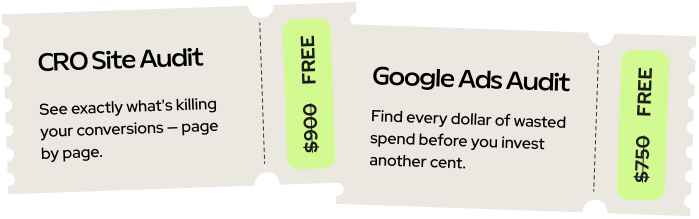
Just honest findings delivered within 2 business days.