


The mistake: treating ad spend as your only growth lever
If you're a Head of Marketing or VP of Growth right now, your week probably looks like this: CPMs are up again, CAC crept a little higher this quarter than last, and yet the instinct is still to push more budget into the same channels. Revenue might even be going up. But the math underneath it is getting worse every month.
This is the mistake almost every scaling Shopify brand makes: treating paid acquisition as the only growth engine. When acquisition is your single lever, every rise in CPM becomes a direct hit to margin, and the only response available to you is spending more to defend the same output. It feels like feeding a machine that returns less every month — and stopping feels like dying faster, so you keep feeding it.
The fix isn't a better ad account or a smarter bidding strategy. It's a second engine that doesn't depend on media costs at all: converting more of the traffic you're already paying for.
Why CAC keeps rising even when your ads haven't changed
Rising CAC in ecommerce usually isn't a sign that your targeting got worse. It's a sign that the auction got more expensive and more crowded, while your website's ability to turn a visitor into a customer stayed exactly the same. You're paying more per click and per impression, but converting the same fraction of people who land on your product pages.
Here's the part most marketing teams don't do the math on: if your conversion rate stays flat while CPMs rise, CAC rises in lockstep — there's no way around it. But if your conversion rate improves, you get more customers from the exact same ad spend, which pulls CAC back down without touching a single campaign. That's the entire logic of pairing paid acquisition with conversion rate optimization (CRO): it attacks the denominator of the CAC equation instead of only fighting the numerator.
The second growth engine: converting what you already paid for
Every visitor who lands on your store already cost you money. Most of them leave without buying — and for most Shopify stores, that's the vast majority of paid traffic. The moment they leave is invisible to you if all you're doing is pulling traffic reports; you can see that they came, and you can see that they didn't buy, but not where or why they said no.
A psychology-first CRO audit exists to make that moment visible. Instead of guessing which product page element is losing customers, the audit walks through the full purchase journey — product pages, variant pickers, trust signals, checkout — and quantifies exactly where revenue is leaking and how much each leak is costing you in dollars. That's fundamentally different from a generic audit that hands you a list of "best practices" copied from a competitor's store. A competitor's homepage might look like it converts well; it might also be bleeding money in ways they haven't noticed either. Copying it without testing it against your own customers' psychology and behavior data is not a strategy — it's a guess wearing a strategy's clothes.
Once the leaks are identified, each one becomes a hypothesis: a specific, testable idea for why customers are dropping off and what change should fix it. Those hypotheses get prioritized by impact and effort, then run as structured A/B tests — not shipped as opinions. That sequencing matters more than most teams realize. Fixing a low-impact element first because it was easy, while a high-impact leak sits untouched, is how CRO efforts stall out and get deprioritized to "next quarter" indefinitely.
The margin math: why CRO gets more valuable as CAC rises
Here's the part that should change how you prioritize budget. Ad performance decays — the same creative fatigues, the same audience gets more expensive to reach, and yesterday's winning campaign needs fresh spend to keep winning today. CRO compounds instead. A test that ships and wins in month one keeps converting in month twelve, on every dollar of traffic you send to that page, regardless of what CPMs are doing.
That gives marketing a lever that's structurally independent of rising media costs. Instead of every quarter being a negotiation between "spend more" and "accept worse CAC," you have a second dial: raise the conversion rate on the traffic you're already buying, and CAC falls without a single change to your media budget. It's the difference between a store that only grows by paying more, and one that grows by getting more efficient with what it already pays for.
This is also why CRO deserves to sit next to paid acquisition in the budget conversation, not below it. If your conversion rate is sitting below industry benchmark, every dollar you spend on ads is being diluted by a leaky funnel before it ever has a chance to become a customer.
Why generic tests and cheap agencies don't move CAC
If you've already tried to fix this — an AI tool spitting out generic test ideas, or a low-cost generalist agency running the same playbook they run for every client — and neither moved the needle, that's not a sign CRO doesn't work for your store. It's a sign the hypotheses weren't built around your actual customers.
AI-generated tests and templated playbooks tend to recommend the same handful of "best practices": add urgency banners, stack trust badges, tweak button colors. Some of those ideas might help. Most won't, because they weren't built from your customer psychology or your store's actual drop-off data — they were built to apply to everyone, which means they're truly built for no one. Every hypothesis should be validated against real customer personas and real behavioral data before a single line of code gets written, not deployed because it worked somewhere else.
If you're evaluating who to trust with this, it's worth reading how to pick a Shopify CRO agency that doesn't just deliver a PDF and reviewing what a real CRO case study should actually prove before you sign anything.
What this looks like when you stop guessing
In practice, treating CRO as a second growth engine means running a short, structured audit — reviewing product pages, checkout flow, trust signals, and merchandising against real shopper behavior — to find where and why customers are leaving before you touch a single design element. That audit gets turned into a prioritized queue of hypotheses, tested one at a time so you know which changes actually move the conversion rate and which don't.
The team running this should function as an extension of yours, not a consultant who disappears after the recommendations doc. That means someone designing the test, someone coding it, someone doing QA, and someone reporting back on what won and what didn't — so your internal team's bandwidth stays free for the work only they can do. And because every test is a bet, the fairest model ties the agency's incentive to the outcome: a fixed price per test, with nothing owed if the test doesn't win.
If your team is stretched thin and CRO keeps getting pushed to next quarter, that structure is the difference between it actually happening and it staying on a backlog forever. For more on diagnosing where to start, this guide on diagnosing low conversion rate walks through the order operations should go in before any redesign begins.
FAQ
Why does CAC keep rising even though our ad targeting hasn't changed?
CAC is a function of two things: how much you pay for traffic, and what percentage of that traffic converts. If CPMs rise and your conversion rate stays flat, CAC rises automatically — even with identical targeting. Raising your conversion rate is the only lever that pushes back against CAC without spending more on media.
Is CRO really a substitute for more ad spend?
CRO isn't a replacement for acquisition, it's a second engine alongside it. It makes every dollar you already spend on ads work harder by converting more of the traffic that dollar buys, so you get more customers and lower CAC without increasing your media budget.
We tried AI-generated tests and a cheap agency — why didn't they move the needle?
Generic tests and templated playbooks are built to apply to any store, which usually means they're tuned to none of them. Hypotheses need to be validated against your actual customers' psychology and behavior data before they're built, not copied from what worked somewhere else.
How do we know where visitors are actually dropping off?
A psychology-first audit reviews the full purchase journey — product pages, trust signals, variant pickers, checkout — and quantifies where revenue is leaking and how much each leak costs, rather than handing you a generic list of best practices.
We don't have bandwidth for another initiative — how does this fit in?
A dedicated team running strategy, design, development, and QA operates autonomously, shipping and reporting on tests without pulling your internal team off their core work. CRO doesn't need to compete for your team's time to move forward.
What if a test doesn't work — are we still paying for it?
On a risk-free, fixed-price-per-test model, you only pay when a test wins. If it loses, there's nothing owed, which means testing to fix rising CAC never becomes its own risk to cash flow.




Not Sure Where Your Store Is Leaking Revenue?
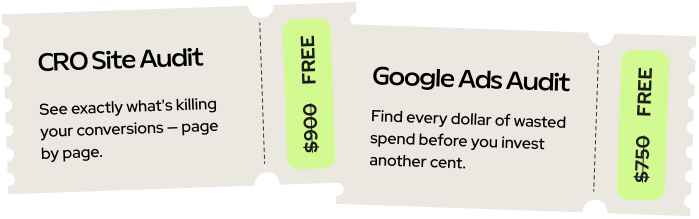
Get a free CRO or Google Ads audit from our team — we'll find what's killing your conversions and show you exactly how to fix it. No pitch, no pressure.
Get a free CRO or Google Ads audit from our team



Wait… Claim your free bonuses
Find out exactly where your store is leaking revenue — and where your ad spend is going to waste. No pitch, just data.
Just honest findings delivered within 2 business days.