


The mistake most shortlists are already making
If you've got three or four CRO agencies in a spreadsheet right now — probably including some mix of Enavi, SplitBase, Invesp, and a handful of newer names — you're likely comparing them on the wrong axis.
Most shortlists rank agencies by case study polish: the biggest revenue number, the shiniest logo wall, the most confident-sounding hypothesis language. That's a mistake, because a case study tells you what happened at one other store, under one other set of conditions, with an audience that isn't yours. It tells you almost nothing about what happens to your risk, your team's time, or your P&L if the engagement goes sideways.
The better question isn't "which agency has the best results?" It's "which agency has a model that makes it structurally hard for me to lose?" That's a scorecard question, not a testimonial question. Below is the scorecard we'd use if we were in your shoes, followed by where Weblics sits on it — and where we don't pretend to be the only option.
Score card criterion 1: who carries the risk if a test loses
Ask every agency on your shortlist one direct question: what happens to my invoice if your test doesn't win?
Most full-stack CRO agencies bill retainers — a monthly fee for a roadmap, a testing cadence, and a team, regardless of whether any individual test moves conversion rate. That's the model behind most of the names you'll find when you search Shopify agency UK or "top Shopify agency." You're paying for effort and access, not for outcomes.
Weblics runs on a fixed price per test, and on our risk-free tier, you only pay when a test wins. If a hypothesis loses, you owe nothing for it. That single term changes the entire relationship: an agency that only gets paid when you win has no incentive to pad a roadmap with low-impact tests just to justify a monthly invoice.
When you're scoring a shortlist, put this question first. If an agency won't answer it plainly, that's the answer.
Score card criterion 2: psychology-first testing vs. templated playbooks
The second thing to check is why each agency is proposing the tests it's proposing.
A lot of CRO work — even from well-regarded shops — starts from a library of "best practice" plays: add urgency badges, default to subscription, stack trust icons near the buy button. These aren't bad ideas on their face. The problem is that a best-practice element copied from a competitor's product page looks identical whether or not it will convert for your customers. Your shopper isn't their shopper. A generalist agency running the same playbook across twenty Shopify stores is optimizing for their delivery speed, not your customer psychology.
At Weblics, every hypothesis is built around your store's real customer personas and validated with a proprietary AI system before a single line of code gets written. We're not asking "what worked for another DTC brand," we're asking "what does the evidence say about how this store's visitors actually decide." That's the difference between a test and a guess wearing a test's clothes.
When you're evaluating a shortlist, ask each agency to walk you through one hypothesis end to end: what data justified it, what customer behavior it's responding to, and what would prove it wrong. If the answer is "this is standard practice," keep asking.
Score card criterion 3: how visible is the work, and how often do you hear about it
The third failure mode ecommerce managers describe most often isn't a bad test — it's silence. You've paid an agency, they delivered a PDF of recommendations, and then the relationship goes quiet until the next invoice. Managing that agency relationship starts eating time that should go to running the store, not chasing a roadmap that never ships.
Score agencies on cadence and ownership, not just strategy quality:
- Do they design, code, test, and QA the change themselves — or does implementation get handed back to your dev team?
- Is there a standing weekly report, or do you have to ask for one?
- Is there a live channel (Slack or similar) where you can see test status in real time?
Weblics runs as a dedicated pod — strategist, designer, developer, QA — that ships the full pipeline autonomously, with weekly reporting and a dedicated Slack channel. Nothing sits in a Google Drive waiting for someone to notice it. If your team is already stretched thin, this is the criterion that determines whether CRO becomes another thing on your plate or actually comes off it.
How the named alternatives typically score
To be fair to your shortlist: agencies like Enavi, SplitBase, and Invesp have each built reputations in this space, generally on retainer-based, roadmap-driven engagements with experienced CRO strategists. If your priority is a long-term strategic partner and you're comfortable with retainer risk, they're reasonable options to evaluate on their own terms — you should still ask them the three scorecard questions above directly.
Where Weblics differentiates is specifically on risk transfer and psychology-first methodology: fixed price per test, pay only when a test wins on our risk-free tier, and hypotheses validated against real customer data rather than a shared industry playbook. If your conversion rate sits below benchmark and you don't yet have a clear system for what to fix first, that prioritization gap is usually where templated agencies show their limits fastest — they run the plays in the order the playbook suggests, not the order your data suggests.
What to ask before you sign with anyone
Before you pick a name off any "best Shopify CRO agency" list — this one included — bring these questions to the actual sales call:
- What do I owe if a test loses?
- Show me one hypothesis and the customer evidence behind it, not the result.
- Who's writing the code and running QA — you, or my dev team?
- How often do I hear from you, and in what format?
- What happens to the winning test in month 12 — does it keep compounding, or does it need to be re-run?
If you want a deeper breakdown of how to read the case studies agencies show you during that process — including which metrics are being quietly left out — see our guide on what real case studies should answer. And if you're earlier in the process and haven't picked a shortlist yet, start with how to pick a CRO agency that doesn't just deliver a PDF.
Why this matters more than the case study wall
CPMs keep rising. CAC creeps up every quarter. Ad spend is starting to feel like the only lever left, and it's slowly working against your margins. That's exactly the environment where the model an agency operates on matters more than the case studies it shows you — because CRO is the second growth engine that turns the traffic you're already paying for into more revenue, independent of what happens to media costs.
A templated playbook run on a retainer doesn't compound that advantage — it just adds a recurring line item next to your ad spend. A psychology-first testing model with risk transferred to the agency does. That's the real distinction behind "best," and it's worth more than any single case study number.
FAQ
Do I need a CRO agency, or can I optimize my Shopify store myself?
You can run tests yourself if you have the internal bandwidth, a way to validate hypotheses against real customer behavior, and the design/dev/QA capacity to ship changes quickly. Most ecommerce teams don't have all three at once — CRO keeps getting pushed to next quarter because no one on staff has the spare time or specialized expertise. An agency's value is filling that specific gap, not replacing judgment you already have.
What's the difference between a CRO agency and a Shopify design agency?
A design agency typically focuses on how a store looks and its overall build. A CRO agency focuses on why visitors leave without buying and runs structured A/B tests to fix it — audits, hypotheses, testing, and iteration, not a one-time redesign.
How is Weblics different from a retainer-based CRO agency?
Weblics prices per test, and on the risk-free tier, you only pay when a test wins — there's nothing owed for a test that loses. Most retainer-based agencies bill monthly for a testing program regardless of individual test outcomes.
How long does it take to see results from a Shopify CRO engagement?
This varies by store traffic and the size of the revenue leak being addressed, so treat any agency's fixed timeline promise with some skepticism and ask what your specific traffic volume implies for statistical significance before committing.
What should a CRO audit actually tell me?
A useful audit identifies exactly where and why visitors are abandoning — not just generic recommendations. If a previous audit didn't leave you with actionable, dollar-quantified findings, that's a sign it wasn't built around your specific customer data.




Not Sure Where Your Store Is Leaking Revenue?
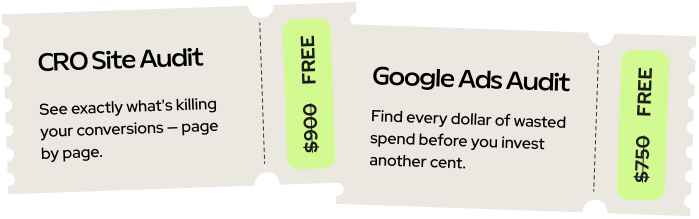
Get a free CRO or Google Ads audit from our team — we'll find what's killing your conversions and show you exactly how to fix it. No pitch, no pressure.
Get a free CRO or Google Ads audit from our team



Wait… Claim your free bonuses
Find out exactly where your store is leaking revenue — and where your ad spend is going to waste. No pitch, just data.
Just honest findings delivered within 2 business days.